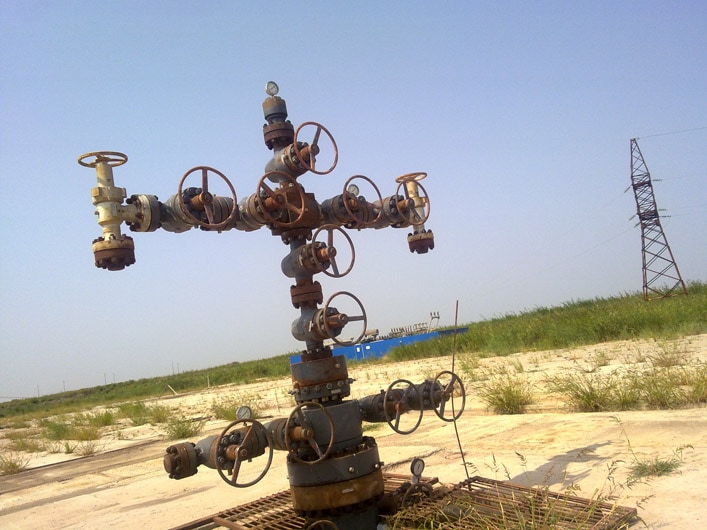
If you are new to the oil and gas industry, the term Christmas tree can be confusing.
It has nothing to do with the holiday.
An oilfield Christmas tree is an assembly of valves, fittings, pressure gauges, and flow control equipment installed at the top of a completed oil or gas well.
Its job is to control the well.
Every barrel of oil, every cubic foot of gas, and much of the produced water leaving a conventional producing well may pass through or be controlled by equipment on the tree.
Operators use it to open and close the well, control production, monitor pressure, provide access for certain well interventions, and safely isolate the well when necessary.
To understand how producing wells work, you need to understand the Christmas tree.
Is a Christmas Tree the Same as a Wellhead?
No.
The terms are sometimes used casually as though they mean the same thing, but technically they refer to different equipment.
The wellhead provides the structural and pressure containing connection at the surface for the casing and tubing strings.
The Christmas tree is installed above the wellhead and contains the valves and flow control equipment used during production.
A simple way to remember the difference is this:
The wellhead supports and seals the well construction.
The Christmas tree controls the producing well.
They work together, which is why people sometimes refer to the entire surface assembly simply as the wellhead.
Why Is It Called a Christmas Tree?
The name comes from the appearance of older assemblies.
With several valves, fittings, gauges, and side outlets arranged around a vertical body, the equipment loosely resembled a decorated tree.
The name remained.
Today, Christmas trees can look very different depending on the type of well.
A simple land well may have a relatively compact assembly.
A high pressure gas well can have much heavier equipment.
Offshore and subsea wells use much more complex tree systems.
The basic purpose remains similar.
Control the well safely.
What Comes Out of the Christmas Tree?
Depending on the well, the production stream can contain:
Oil
Natural gas
Produced water
Condensate
Sand
Small amounts of other solids
The tree directs the produced fluids into the flowline.
From there, they travel toward production equipment such as separators, heater treaters, tanks, compressors, or processing facilities.
The tree is therefore the transition point between the underground well and the surface production system.
What Is the Master Valve?
One of the most important valves on the tree is the master valve.
It is located in the main vertical flow path.
Its purpose is to isolate the well.
Many trees have more than one master valve.
You may hear terms such as lower master valve and upper master valve.
Having multiple barriers provides additional control and allows certain maintenance activities to be performed while maintaining well isolation.
The exact arrangement depends on tree design and operating requirements.
Why Isn’t the Master Valve Used to Control Production Rate?
A master valve is primarily an isolation valve.
It is generally intended to be fully open or fully closed during normal operation.
Using an isolation valve partially open for routine flow control can expose its internal sealing surfaces to unnecessary erosion and damage.
Production rate is normally controlled using equipment designed for throttling, particularly the choke.
This distinction is important throughout process operations.
A valve designed to isolate is not necessarily a valve designed to regulate.
What Is the Wing Valve?
The production wing valve controls the path from the tree into the production flowline.
Picture the main tree as a vertical assembly.
The production outlet extends from the side.
That side outlet is the wing.
The valve controlling it is therefore called the wing valve.
During normal production, the master valve and production wing valve are typically open while flow passes toward the choke and flowline.
Closing the wing valve can isolate the downstream production system from the well.
What Is the Kill Wing Valve?
Some Christmas trees have another side outlet used for pumping fluid into the well.
This side can be called the kill wing.
It can provide a connection for operations involving well control, pressure testing, chemical injection, or well intervention depending on the tree design.
The term comes from the ability to pump fluid into the well during certain operations intended to control or kill the well.
Not every tree has exactly the same arrangement.
What Does It Mean to Kill a Well?
Killing a well means establishing conditions that prevent reservoir fluids from flowing uncontrollably to the surface.
One common approach is placing fluid of sufficient density into the well so that hydrostatic pressure balances or exceeds reservoir pressure.
This is not the same as permanently abandoning the well.
A well may be killed temporarily so maintenance or intervention can be performed.
Afterward, it may be returned to production.
What Is the Swab Valve?
The swab valve is normally located near the top of a conventional Christmas tree.
It provides vertical access into the well.
This access can be useful during operations involving wireline, slickline, coiled tubing, or other intervention equipment, depending on the well configuration.
During normal production, the swab valve is usually closed.
Opening it is not a routine production adjustment.
It is part of carefully planned well intervention work.
Why Is Vertical Access Important?
Many tools need to travel directly down the production tubing.
For example, an operator may need to:
Set or retrieve downhole equipment
Run pressure gauges
Remove deposits
Install plugs
Retrieve valves
Perform diagnostic work
The tree therefore needs a controlled way to provide access without dismantling the entire wellhead system.
The swab valve helps provide that route.
What Is a Choke?
The choke controls the production rate by creating a restriction in the flow path.
This sounds inefficient.
Why deliberately restrict a well that you spent millions of dollars drilling?
Because uncontrolled maximum flow is rarely the objective.
The operator may need to control pressure.
The facility has capacity limits.
Excessive production can increase sand problems.
High drawdown can encourage unwanted water or gas production.
Flowlines have limits.
Separators have limits.
A choke allows the well to produce under controlled conditions.
What Is a Fixed Choke?
A fixed choke uses an opening of a selected size.
Changing the production restriction requires changing the choke size or internal component.
Fixed chokes are mechanically simple and can provide stable flow control.
They are common in many production applications.
Operators may refer to choke size using dimensions specific to the equipment and local operating practice.
What Is an Adjustable Choke?
An adjustable choke allows the restriction to be changed without replacing a fixed opening each time.
The operator can increase or decrease the opening.
Automated choke systems can also adjust flow based on process control requirements.
Adjustable chokes are useful when well conditions change frequently.
They can also be important during well cleanup and testing when production is deliberately changed through several flow conditions.
Why Does Pressure Drop Across a Choke?
The choke forces fluid through a restricted area.
Velocity changes and energy is dissipated.
Pressure downstream becomes lower than pressure upstream.
That pressure reduction is exactly what allows the choke to control the well.
A producing well might have very high pressure at the tree but much lower pressure in the flowline.
The choke manages the transition.
Why Can Chokes Erode?
Oil and gas production is not always clean.
The stream can contain sand and other solids.
Those particles travel at high velocity through the restricted choke opening.
The result can be severe erosion.
Gas wells and wells producing sand can be particularly demanding.
As the choke erodes, the effective opening may change.
Production behavior can change with it.
This is why operators monitor pressure and flow rather than assuming a choke remains unchanged forever.
Why Are There Pressure Gauges on the Tree?
Pressure is one of the quickest ways to understand what a well is doing.
Operators may monitor tubing pressure and casing pressure.
Depending on the completion, these pressures can provide information about well performance and possible problems.
A sudden pressure change can indicate:
A production change
A restriction
A closed valve
A flowline problem
Artificial lift behavior
A leak
A shutdown
Changing reservoir or well conditions
One pressure reading rarely tells the entire story.
Trends are much more useful.
What Is Tubing Pressure?
Tubing pressure is the pressure associated with the production tubing at the surface.
The production tubing is normally the primary path through which reservoir fluids travel upward.
Tubing pressure is therefore closely connected to well production and surface backpressure.
If the well is shut in, tubing pressure can rise.
When the well is flowing, the pressure reflects the interaction between reservoir inflow, fluid behavior, tubing losses, choke restriction, and downstream pressure.
What Is Casing Pressure?
Casing pressure is measured in an annular space outside the production tubing, depending on the completion design.
Its meaning depends heavily on how the well is constructed.
In a gas lift well, casing pressure may be associated with injected lift gas.
In another well, unexpected annular pressure could require investigation.
You cannot interpret casing pressure correctly without understanding the completion.
The same numerical pressure can be completely normal on one well and abnormal on another.
Why Does a Christmas Tree Need So Many Valves?
Redundancy and operational flexibility.
A producing well contains stored pressure and has a direct connection to an underground reservoir.
You do not want the entire system dependent on one valve.
Multiple valves can provide separate barriers.
They can isolate different sections of equipment.
They allow maintenance and intervention activities to be planned safely.
They also provide different flow paths for production and well servicing.
What looks like unnecessary complexity is largely about controlling pressure and maintaining barriers.
What Is a Surface Safety Valve?
Some wells use an actuated valve that can automatically close when a shutdown signal occurs.
The exact arrangement varies.
The safety system may respond to abnormal conditions such as excessive pressure, low pressure, fire detection, emergency shutdown activation, or loss of control pressure.
The purpose is to isolate the well from the production system when conditions become unsafe.
This is especially important where wells have significant flowing pressure.
What Happens During an Emergency Shutdown?
The exact sequence depends on facility design.
Generally, an emergency shutdown system places equipment into a safer condition.
Selected valves close.
Production may stop.
Compressors or pumps may shut down.
Pressure relief and depressurization systems remain available where required.
The Christmas tree can form an important part of this isolation strategy.
The goal is not simply to turn everything off instantly.
The shutdown sequence has to control stored pressure and process inventory safely.
What Is a Downhole Safety Valve?
Some wells have a safety valve installed below the surface inside the production tubing.
This is commonly called a subsurface safety valve.
It provides another method of shutting off flow from the reservoir.
Such valves are especially important in many offshore wells because damage at the surface could compromise surface equipment.
A downhole barrier can isolate flow below the damaged area.
Are All Oil Wells Equipped With Downhole Safety Valves?
No.
Requirements and designs vary with location, regulations, well type, risk, and operating environment.
Offshore wells often have different safety requirements from low pressure land wells.
A small mature land producer and a high rate offshore gas well may both have Christmas trees, but the complete safety systems around them can be dramatically different.
What Is a Subsea Christmas Tree?
Offshore wells can be completed on the seabed.
In that case, the Christmas tree is installed underwater at the well.
This is a subsea tree.
Its fundamental jobs are familiar:
Control production.
Provide isolation.
Manage pressure.
Provide connections for intervention and control.
The engineering challenge is much greater because the equipment may sit hundreds or thousands of metres below the ocean surface.
How Are Subsea Trees Operated?
They are designed for remote operation.
Hydraulic, electrical, and electronic control systems can be used depending on the development.
Operators monitor and control the well from an offshore facility or another control location.
Remotely operated vehicles can also perform certain subsea tasks.
Reliability is extremely important because repairing equipment on the seabed is much more difficult and expensive than servicing a land well.
What Is the Difference Between a Vertical Tree and a Horizontal Tree?
These terms describe different subsea tree configurations and the arrangement of valves and tubing access.
In a vertical tree, major production valves are arranged in a configuration where the tree is installed after the tubing hanger in a traditional sequence.
A horizontal tree uses a different arrangement that can provide direct vertical access to the tubing while major production valves are positioned differently within the tree body.
The best design depends on the field development and intervention strategy.
For someone learning basic production operations, the important point is that subsea trees do not all use the same architecture.
How Much Pressure Can a Christmas Tree Handle?
That depends on its pressure rating and design.
Low pressure producing wells require very different equipment from high pressure wells.
Tree components are selected according to expected well pressure, temperature, fluid composition, operating environment, and applicable engineering requirements.
You should never assume equipment can handle a pressure simply because another tree that looks similar can.
The equipment rating matters.
Temperature Matters Too
Pressure gets most of the attention, but temperature affects tree design as well.
Produced fluids can be hot.
Very cold operating conditions create other problems.
Material properties change with temperature.
Seals must perform within their intended range.
Wax, hydrates, and freezing water can affect flow.
Thermal expansion also matters.
High pressure and extreme temperature together can create demanding design conditions.
Sour Wells Need Special Consideration
Some wells produce hydrogen sulfide.
These are commonly called sour wells.
Hydrogen sulfide is highly toxic and can also create material challenges.
Equipment exposed to sour service must be selected appropriately.
Materials that perform well in one environment can become vulnerable to specific cracking mechanisms in another.
Tree design therefore depends not just on pressure and flow rate but also on what the well actually produces.
Why Are Christmas Trees So Heavy?
They contain thick pressure containing components.
High pressure requires strong equipment.
Valves, flanges, bodies, actuators, and connections can become extremely heavy.
The wellhead has to support these loads.
Installation and maintenance may require lifting equipment.
On high pressure or subsea developments, the complete tree assembly can be a major engineered system rather than a collection of small valves.
Can a Christmas Tree Leak?
Yes.
Like any pressure containing equipment, trees require inspection and maintenance.
Potential leak locations can include valve stems, seals, flanges, fittings, connections, and other components.
Corrosion and erosion can also affect equipment condition.
A leak around a producing well requires proper assessment because the fluid may be flammable, toxic, or under substantial pressure.
The correct response depends on the location and severity of the leak.
What Happens If a Tree Valve Will Not Close?
That can become a serious operational problem.
The next steps depend on which valve is affected and what other barriers remain available.
One reason trees contain multiple isolation devices is to avoid depending on a single component.
Well intervention may be required if a critical valve cannot provide the necessary isolation.
Operators do not simply disassemble pressure containing equipment because a valve appears stuck.
The well must first be placed into a condition where the work can be performed safely.
Can Christmas Tree Valves Be Replaced?
Some components can be serviced or replaced under appropriate conditions.
The method depends on tree design, valve location, well pressure, available barriers, and the work being performed.
Certain operations may require the well to be killed.
Others can sometimes use specialized intervention techniques.
The planning revolves around one essential question:
What barriers prevent reservoir pressure from reaching the people working on the equipment?
Why Are Barrier Philosophies So Important?
A producing well is not an ordinary pipe.
Behind the tree may be a reservoir capable of continuously supplying fluid and pressure.
Closing a valve creates a barrier.
But operations involving maintenance or intervention often require engineers to consider what happens if that barrier fails.
Additional independent barriers may therefore be required.
Well integrity management is built around knowing where those barriers are and whether they can actually perform their intended function.
What Is a Tree Cap?
The top of the tree is normally closed with equipment designed to contain pressure and provide the required access arrangement.
Depending on the tree, this can include a tree cap or related pressure containing components.
The top section may need to be removed or configured differently during certain intervention operations.
Again, the work cannot begin simply because the well is not producing.
Pressure can remain trapped below closed valves.
A Shut Well Can Still Be Dangerous
This is one of the most important concepts for anyone new to oil and gas operations.
No flow does not mean no pressure.
A shut well may contain substantial trapped pressure.
The reservoir may continue applying pressure against closed barriers.
A gauge may show pressure even though no fluid is moving.
Before equipment is opened, the relevant section must be properly isolated, depressurized, and verified according to the required procedure.
Never confuse zero flow with zero energy.
What Happens When the Well Is Opened?
Opening a well is normally controlled.
Valves are placed in the required positions.
Downstream equipment must be ready.
Pressure conditions are checked.
The choke may initially provide significant restriction.
Production is introduced into the flowline.
Operators monitor pressure, flow, separator conditions, and other relevant variables.
Opening a high pressure well too aggressively can create unnecessary process disturbances.
Good startup is controlled startup.
Why Can Opening the Choke Increase Water or Sand?
Opening the choke generally reduces restriction and can increase well drawdown.
That may increase production.
But stronger drawdown can also change what enters the well.
Weak formations may produce more sand.
Water can move more aggressively toward the completion.
Gas production can increase.
Surface equipment may receive larger fluid rates.
The largest choke opening is therefore not automatically the best operating condition.
What Happens Downstream of the Christmas Tree?
After passing through the production outlet and choke, fluids enter the flowline.
The next destination depends on the facility.
A typical production system may send the wellstream toward a separator.
Gas separates from liquid.
Oil and water are separated further.
Gas may enter compression or processing.
Oil may enter treatment and storage.
Produced water may enter treatment, disposal, or injection systems.
The Christmas tree is only the beginning of the surface production journey.
What Should a New Operator Learn About a Christmas Tree?
Do not start by memorizing valve names alone.
Understand the flow paths.
Which valve isolates the reservoir from the upper tree?
Which valve isolates the production flowline?
Where is the choke?
Where is tubing pressure measured?
Where is casing pressure measured?
Which connection provides intervention access?
What position should each valve normally be in?
What happens downstream if a particular valve closes?
Once the flow path makes sense, the valve names become much easier to remember.
Why Christmas Tree Knowledge Appears in Oil and Gas Interviews
Christmas trees combine several fundamental industry concepts in one piece of equipment.
Pressure.
Valves.
Flow control.
Well barriers.
Production tubing.
Casing.
Chokes.
Safety systems.
Well intervention.
A candidate who can explain the tree clearly usually demonstrates more than memorization.
They show that they understand how the underground well connects to the surface facility.
Frequently Asked Questions
What is a Christmas tree in oil and gas?
A Christmas tree is an assembly of valves, fittings, pressure monitoring equipment, and flow control devices installed above a completed well to control production and provide well isolation.
Is a Christmas tree the same as a wellhead?
No. The wellhead supports and seals the casing and tubing arrangement, while the Christmas tree contains much of the equipment used to control the producing well.
Why is it called a Christmas tree?
The arrangement of valves and fittings on traditional designs loosely resembled a decorated tree, which led to the name.
What does the master valve do?
The master valve provides isolation in the main vertical flow path of the well.
What does the wing valve do?
The production wing valve controls the flow path from the tree toward the production flowline.
What is the swab valve used for?
The swab valve provides vertical access into the well for certain intervention and diagnostic operations.
What does a choke do on an oil well?
The choke creates a controlled restriction that helps regulate production rate and pressure.
Why not leave the choke completely open?
Maximum unrestricted flow can create excessive drawdown, sand production, unwanted water or gas, erosion, and overload of surface equipment.
What is tubing pressure?
Tubing pressure is pressure measured at the surface in the production tubing system. It is influenced by well inflow, fluid behavior, tubing pressure loss, choke conditions, and downstream pressure.
What is casing pressure?
Casing pressure is pressure measured in an annular space outside the production tubing. Its meaning depends on the well completion and operating method.
What is a subsea Christmas tree?
A subsea Christmas tree is a well control assembly installed on a well located on the seabed.
Can a Christmas tree shut down a well automatically?
Some trees include actuated safety valves connected to shutdown systems that can isolate the well when specified abnormal or emergency conditions occur.
Can a well still have pressure when the Christmas tree is closed?
Yes. Closing the tree stops flow but does not necessarily eliminate pressure. Reservoir pressure and trapped pressure can remain behind the closed valves.
Why do Christmas trees have multiple valves?
Multiple valves provide isolation, operational flexibility, access for intervention, and additional barriers for managing well pressure safely.