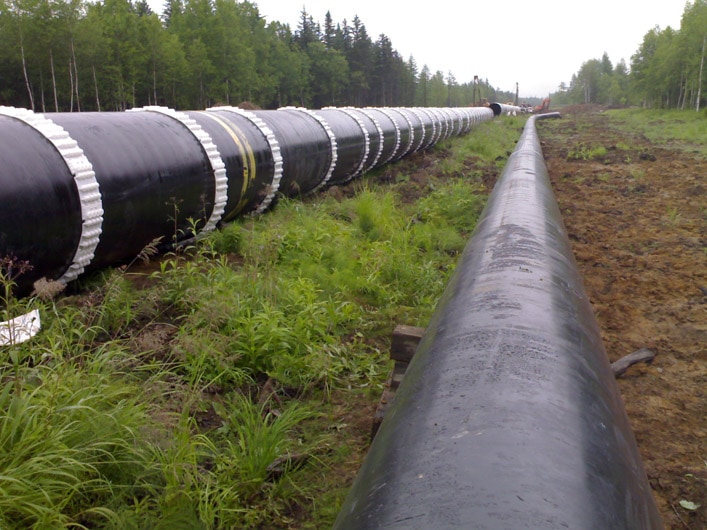
A pipeline can leave a compressor station at high pressure and arrive many kilometres later at a much lower pressure.
Nothing has leaked.
No valve necessarily failed.
The pipeline may be operating exactly as designed.
Pressure is lost whenever fluid moves through a real piping system.
That pressure loss is one of the basic engineering constraints behind almost every oil and gas pipeline.
It determines how much product can move through the line, how large the pipe needs to be, where compressors or pumps are required, and how much energy it takes to transport oil or natural gas hundreds of kilometres.
For operators, pressure changes are also useful clues.
A normal pressure drop tells you the pipeline is flowing.
An abnormal pressure drop can tell you something has changed.
Pressure Is What Moves the Fluid
Fluid does not move through a pipeline simply because the pipe points toward the destination.
There needs to be a pressure difference.
Higher pressure exists upstream.
Lower pressure exists downstream.
That difference provides the energy needed to move the fluid.
For a simple example, imagine a pipeline with 1,000 psi at one end and 700 psi at the other.
The 300 psi difference is doing work.
Part of that pressure difference is being consumed as the fluid travels through the system.
If the pipeline were perfectly frictionless and completely level, the behavior would be very different.
Real pipelines are neither.
Friction Is the Main Reason Pressure Falls
Fluid moving through a pipe experiences resistance.
Some resistance occurs between the moving fluid and the pipe wall.
Additional resistance occurs within the fluid itself as different layers move at different velocities.
This friction converts some of the fluid’s mechanical energy into heat.
The result is a gradual loss of pressure in the direction of flow.
The longer the pipeline, the more opportunity there is for friction to act.
That is why transporting gas across a continent requires compressor stations along the route instead of one compressor at the beginning.
Flow Rate Makes a Huge Difference
Imagine pushing a small amount of water through a garden hose.
Now try pushing ten times as much through the same hose.
The second situation requires much more pressure.
Pipelines behave the same way.
As flow rate increases, velocity generally increases.
Higher velocity produces greater friction losses.
This means pipeline capacity cannot be increased indefinitely simply by opening another valve upstream.
At some point, the pressure required to push additional fluid through the existing pipe becomes too high or the available downstream pressure becomes too low.
Operators call this a hydraulic limitation.
Pipeline Diameter Matters
A large diameter pipeline can transport much more fluid with a lower pressure loss than a small diameter pipeline under comparable conditions.
This is one reason major transmission pipelines are so large.
Increasing diameter creates more flow area.
For a given flow rate, velocity decreases.
Lower velocity generally means lower friction losses.
The difference can be enormous.
A relatively small increase in pipeline diameter can substantially change the amount of product that can be transported.
The problem is cost.
Large diameter pipe costs more.
Trenching costs increase.
Valves become larger.
Fittings become larger.
Construction equipment becomes heavier.
Engineers therefore balance construction cost against long term operating cost and required capacity.
Why Not Build Every Pipeline Much Bigger?
Because an oversized pipeline can be an expensive mistake too.
Suppose a field is expected to produce enough gas to justify a twenty inch pipeline.
Building a forty inch line would certainly reduce pressure loss.
But the additional steel and construction cost might never be recovered.
The pipeline also has to operate effectively over changing production rates.
Oil and gas fields rarely produce exactly the same volume for their entire lives.
Production can rise rapidly during development and later decline.
Good pipeline design considers the expected production profile, not simply the maximum possible rate.
Pipe Roughness Matters
A brand new steel pipeline is relatively smooth inside.
It is not perfectly smooth.
The microscopic texture of the internal wall creates resistance.
Over time, the effective roughness can change.
Corrosion can make surfaces rougher.
Deposits can accumulate.
Scale can form.
Wax can build up.
Debris can remain after construction or maintenance.
A rougher internal surface creates more resistance to flow.
That increases pressure loss.
This is one reason an older pipeline may not hydraulically behave exactly as it did when first installed.
Wax Can Slowly Reduce Pipeline Capacity
Some crude oils contain paraffin components that can deposit as the oil cools.
Imagine a clean pipeline with a twelve inch internal diameter.
Now imagine wax gradually coating the inside wall.
The effective diameter becomes smaller.
Even a relatively modest reduction in internal diameter can significantly affect hydraulic performance.
Flow area decreases.
Velocity may increase.
Friction increases.
The pressure required to maintain the same production rate rises.
Operators may therefore pig pipelines regularly to remove wax before it becomes a serious restriction.
Scale Can Do the Same Thing
Scale is another type of deposit.
Minerals dissolved in produced water can precipitate when pressure, temperature, or water chemistry changes.
Those minerals can form hard deposits inside piping and equipment.
Unlike soft wax, scale can become extremely difficult to remove.
A line affected by scale may show increasing pressure differential over time.
If the upstream pressure keeps rising while the downstream pressure remains similar, something inside the flow path may be becoming more restrictive.
The pressure readings do not tell you automatically that the restriction is scale.
They tell you where to start looking.
Valves Create Pressure Loss Too
Every change in the flow path creates some resistance.
Valves are no exception.
A fully open, full bore valve may create relatively little pressure loss.
A partially closed valve can create a large restriction.
That is sometimes exactly what the operator wants.
Control valves intentionally create pressure drops to regulate flow, pressure, or level.
Chokes do the same thing at producing wells.
The pressure loss is not wasted by accident.
It is deliberately being used to control the process.
A Partially Closed Valve Can Look Like a Pipeline Problem
Suppose a pipeline normally operates with 900 psi upstream and 800 psi downstream.
One day the upstream pressure rises to 1,050 psi while downstream pressure remains around 800 psi.
An operator may start wondering whether the line is becoming plugged.
That is possible.
But perhaps someone left a valve partially closed.
Or a valve actuator failed.
Or a control valve changed position because of another process condition.
Good troubleshooting begins with verifying the simple things before assuming the pipeline has developed a complicated internal problem.
Elevation Changes Pressure
Pipelines rarely run across perfectly flat terrain.
They travel uphill.
Then downhill.
They cross valleys.
They climb ridges.
Elevation changes pressure because lifting liquid requires energy.
If an oil pipeline climbs a mountain, pressure is consumed overcoming the weight of the liquid.
If the same pipeline later descends, some pressure can be recovered.
This effect is particularly important for liquid pipelines because liquids are relatively dense.
A pipeline profile therefore matters just as much as its horizontal length.
Why Hills Can Create Strange Pressure Behavior
Suppose a pipeline leaves a facility and climbs significantly before descending toward another facility.
The highest point can become hydraulically important.
The upstream pump needs enough pressure to move the liquid all the way over that high point.
The pressure at the final destination may look acceptable while pressure near the top of the hill approaches a very different condition.
For certain liquids, engineers also have to ensure pressure does not fall too low and create vaporization or other operational problems.
Pipeline hydraulics are therefore calculated along the entire route, not just from the first gauge to the last one.
Gas Behaves Differently From Oil
Natural gas is compressible.
That makes gas pipeline hydraulics more complicated.
As pressure falls, gas expands.
Its density changes.
Velocity changes.
Temperature can change.
All of those changes influence pressure loss.
An oil pipeline carrying a relatively incompressible liquid behaves much more simply by comparison.
For long natural gas transmission systems, engineers use specialized equations and computer models to predict pressure and flow throughout the network.
Why Natural Gas Pipelines Need Compressor Stations
Gas gradually loses pressure as it travels through the pipeline.
Eventually the pressure difference available to move the gas becomes insufficient.
A compressor station increases the gas pressure again.
The gas then continues down the next section of pipeline.
Another compressor may be required farther along.
Large transmission systems can contain many compressor stations.
Their spacing depends on pipeline diameter, gas flow, operating pressures, terrain, network design, and other factors.
The compressors are essentially replacing the pressure energy lost during transportation.
Compressors Consume Energy
Moving natural gas is not free.
Compressing gas requires substantial power.
Some compressor stations use natural gas engines.
Others use gas turbines.
Some use large electric motors.
The higher the pressure loss through the pipeline, the more compression may be required to maintain the desired delivery rate.
This creates a direct connection between pipeline condition and operating cost.
A dirty or unnecessarily restrictive system does not only reduce capacity.
It can increase energy consumption.
Oil Pipelines Use Pumps Instead
Liquids are normally moved using pumps rather than gas compressors.
A pump increases the liquid pressure.
That pressure is then gradually consumed by friction and elevation changes as the oil travels through the pipeline.
On a long pipeline, additional pump stations may be required along the route.
The basic purpose is similar to compressor stations in gas transmission.
Add energy.
Move the product.
Replace the pressure that has been lost.
Temperature Changes Everything
Fluid viscosity changes with temperature.
For crude oil, this can be extremely important.
Warm crude may flow relatively easily.
Cool the same crude and it may become much more viscous.
Higher viscosity generally means greater resistance to flow.
This is why cold weather can significantly affect some oil pipelines.
The pump may need to create more pressure to move the same amount of crude.
In heavy oil systems, temperature management can become a major operating consideration.
What Is Viscosity?
Viscosity is essentially a measure of a fluid’s resistance to flowing.
Water has relatively low viscosity.
Honey has much higher viscosity.
Crude oils cover a very broad range.
Some light crude oils flow easily.
Heavy crude can be extremely viscous.
Trying to move thick crude through a long pipeline requires more pressure than moving a much lighter fluid under similar conditions.
This is why simply knowing the pipeline diameter and length is not enough.
You need to know what is inside it.
Diluent Can Make Heavy Oil Easier to Move
Very heavy crude or bitumen may be too viscous for practical pipeline transportation in its original condition.
One solution is blending it with a lighter hydrocarbon called diluent.
The lighter material reduces the viscosity of the mixture.
The resulting blend flows more easily.
This is common in heavy oil producing regions.
The pipeline is not simply transporting crude.
It may be transporting a carefully designed blend created specifically to meet transportation requirements.
Multiphase Pipelines Are More Complicated Again
Some pipelines carry one phase.
A gas transmission pipeline may be designed primarily for dry natural gas.
A crude transmission pipeline may carry stabilized liquid.
Production flowlines can be much messier.
They may carry oil, natural gas, and produced water at the same time.
This is called multiphase flow.
The phases do not necessarily move uniformly.
Gas can travel quickly along the top of a pipe.
Liquid can collect along the bottom.
Large liquid slugs can form.
Flow patterns can change with velocity and terrain.
Predicting pressure loss in multiphase pipelines therefore requires more sophisticated modeling.
What Is Liquid Holdup?
In a gas dominated multiphase pipeline, some liquid can remain inside the line rather than moving at exactly the same velocity as the gas.
This is called liquid holdup.
The amount of liquid inside the pipe affects pressure loss.
It also affects the behavior of the entire production system.
If enough liquid accumulates, the pipeline can become increasingly difficult for the gas to push.
This can eventually contribute to unstable flow.
Low Points Can Collect Liquid
Terrain matters enormously in multiphase flow.
Picture a pipeline crossing rolling terrain.
Liquid tends to accumulate in low sections.
Gas pressure builds behind the liquid.
Eventually the gas pushes some of the accumulated liquid out of the low point.
A large volume may then move downstream as a slug.
This produces changing pressure and flow rather than a smooth steady condition.
A separator receiving the pipeline may suddenly receive much more liquid than normal.
That is why pipeline geometry is important when designing upstream production systems.
What Is Slugging?
Slugging occurs when gas and liquid move through a pipeline in an unstable pattern that produces alternating periods of high liquid and high gas flow.
There are several types and causes of slugging.
For an operator, the important part is what it does to the facility.
Separator levels can rise rapidly.
Gas flow can fluctuate.
Pressure can oscillate.
Compressors may struggle.
Control valves move more aggressively.
Production can become difficult to stabilize.
The pipeline itself can therefore create disturbances that appear at the processing facility kilometres away.
Pipeline Pressure Can Tell You Where the Problem Is
Imagine gauges at several locations along a pipeline.
Under normal operation:
Point A: 1,000 psi
Point B: 900 psi
Point C: 800 psi
Now the readings become:
Point A: 1,100 psi
Point B: 1,000 psi
Point C: 800 psi
That pattern suggests the additional pressure loss is occurring somewhere between B and C.
You still do not know the cause.
But you have narrowed the location.
This is why pressure transmitters distributed through a pipeline network can be extremely useful for troubleshooting.
Sudden Pressure Loss Is Different From Gradual Pressure Loss
A restriction that develops over six months tells a different story from one that appears in thirty seconds.
Gradual changes might suggest deposit buildup, increasing roughness, wax, scale, changing fluid properties, or slowly changing operating conditions.
A sudden pressure change might involve a valve movement, equipment trip, rupture, rapid blockage, instrumentation failure, or another abrupt event.
Time is information.
Good operators do not look only at the pressure value.
They look at how quickly it changed.
Pressure Drop Can Help Detect a Plugged Filter
This principle is used throughout oil and gas facilities.
Place one pressure measurement upstream of a filter.
Place another downstream.
When the filter is clean, the pressure difference may be small.
As debris accumulates, resistance increases.
The pressure differential grows.
At a certain point, the filter needs cleaning or replacement.
The same idea applies to strainers, coalescers, some heat exchangers, and other equipment.
Differential pressure is often more informative than either pressure by itself.
What Is Differential Pressure?
Differential pressure is simply the difference between two pressures.
If upstream pressure is 500 psi and downstream pressure is 470 psi, differential pressure is 30 psi.
Whether 30 psi is acceptable depends on the equipment.
For one piece of equipment it may be normal.
For another it may indicate severe restriction.
This is why operators work with normal operating ranges rather than deciding whether a pressure is good or bad in isolation.
Can Too Much Pressure Drop Damage Equipment?
Yes.
Pressure drop means energy is being dissipated.
Across control valves and chokes, very large pressure reductions can create high velocities and difficult flow conditions.
Liquids may begin vaporizing.
Gas expansion can produce significant cooling.
Noise and vibration can increase.
Erosion can become a concern.
Control valves therefore have to be selected for the pressure reduction they are expected to handle.
A valve that physically fits between two flanges is not automatically suitable for the service.
What Is Cavitation?
Cavitation can occur in liquid systems when local pressure falls low enough for vapor bubbles to form.
Those bubbles later collapse when they enter a higher pressure region.
The collapse can produce intense localized forces.
Over time, cavitation can damage pumps, valves, and other equipment.
Operators may hear characteristic noise or see vibration and poor performance.
This is another reason pressure should not be considered only in terms of whether a pipeline can physically contain it.
Pressure that becomes too low can also create problems.
A Leak Can Change the Pressure Profile
If product leaves a pipeline through an unintended opening, the hydraulic behavior changes.
Pressures and flows can respond.
Pipeline monitoring systems can use combinations of pressure, flow, inventory balance, and computational models to help identify abnormal conditions.
However, not every pressure change means there is a leak.
Customer demand changes.
Compressor operations change.
Valves move.
Pumps start and stop.
Flow rates change.
This is why leak detection requires more than watching one pressure gauge.
Why Operators Compare Pressure and Flow Together
Suppose pressure drop increases.
What does that mean?
If flow rate also increased significantly, the higher pressure loss may be completely normal.
If flow rate stayed the same while pressure drop gradually doubled, that deserves investigation.
Pressure and flow are connected.
Looking at either one alone can create misleading conclusions.
The same principle applies throughout process operations.
Always ask what the rest of the system is doing.
Can a Bigger Pump Solve Excessive Pressure Drop?
Technically, additional pumping power may overcome more resistance.
That does not mean it is always the right solution.
Suppose wax has reduced the pipeline’s effective diameter.
Installing a larger pump could force more liquid through the restriction.
It could also increase energy cost while leaving the underlying problem untouched.
Cleaning the pipeline may restore capacity more economically.
Engineering is rarely about applying the biggest available piece of equipment.
It is about identifying what is limiting the system.
Why Pipeline Pigging Helps
Cleaning pigs travel through pipelines and remove deposits from the internal wall.
Depending on the system, pigging can remove wax, liquids, debris, or other accumulated material.
A cleaner internal surface can reduce restrictions and help maintain flow capacity.
Pigging is therefore not only a housekeeping operation.
It can directly affect pipeline hydraulics.
Operators may track pressures before and after pigging to evaluate whether the line’s performance improved.
What Happens When a Pig Passes Through?
Pressure can change as a pig moves.
The flowing product pushes the pig forward.
The pig itself creates resistance.
Material being removed may accumulate in front of it.
Operators monitor the run and prepare the receiving facility for whatever arrives with the pig.
In certain pipelines, a cleaning operation can send significant quantities of liquid, wax, or debris toward the receiver.
A pigging operation therefore requires planning even though the basic idea sounds simple.
Why Compressor Suction Pressure Matters
Consider a gas compressor station.
The compressor raises pressure from the suction side to the discharge side.
If pipeline pressure upstream falls too low, compressor performance can be affected.
If downstream pressure becomes too high, the required compression ratio increases.
Compressor stations therefore operate as part of the entire pipeline network.
Changing conditions hundreds of kilometres away can influence how individual compressors need to operate.
Modern transmission systems use centralized monitoring and control to coordinate these changes.
Linepack Makes Gas Pipelines Unusual
Natural gas pipelines can store a certain amount of additional gas simply by operating at higher pressure.
This inventory is commonly called linepack.
Because gas is compressible, raising pipeline pressure increases the mass of gas contained inside the pipe.
Operators can use linepack to help balance short term changes between supply and demand.
This does not turn the pipeline into unlimited storage.
Operating pressure limits still apply.
But it gives gas transmission networks flexibility that liquid pipelines do not have in quite the same way.
Why Does Gas Pressure Fall When Demand Increases?
Imagine customers downstream suddenly begin taking more gas.
More gas flows through the system.
Higher flow generally increases friction losses.
At the same time, gas is being removed from the downstream portion of the network more rapidly.
Pressure can begin falling unless additional supply or compression responds.
Pipeline control centers continuously manage these relationships.
This is why a gas transmission system behaves more like a dynamic network than a simple pipe connecting point A to point B.
Pressure Drop Costs Money
Every psi lost to unnecessary resistance eventually has an economic consequence.
Pumps require electricity or fuel.
Compressors require substantial power.
Equipment wears.
Maximum throughput may be reduced.
Additional stations may be required.
A pipeline that was hydraulically efficient when clean can become more expensive to operate if deposits, corrosion, restrictions, or other conditions increase resistance.
This is why pressure loss is not merely an engineering calculation performed during design.
It remains an operating concern for the life of the pipeline.
Frequently Asked Questions
Why does pipeline pressure decrease over distance?
Pressure decreases because energy is lost to friction as fluid moves through the pipe. Elevation changes, valves, fittings, fluid properties, deposits, and other restrictions can add additional pressure loss.
Does a longer pipeline have more pressure drop?
Generally yes, assuming other conditions remain similar. A longer pipeline provides more surface area over which friction acts.
Does a larger pipe reduce pressure drop?
For the same flow rate, increasing pipe diameter generally reduces fluid velocity and friction losses, which can greatly reduce pressure drop.
Why do natural gas pipelines need compressor stations?
Natural gas loses pressure as it moves through long pipelines. Compressor stations periodically increase the pressure so the gas can continue flowing toward customers.
Why do oil pipelines need pump stations?
Pumps add pressure energy to the liquid to overcome friction, elevation changes, and other hydraulic resistance along the route.
Can wax cause high pipeline pressure?
Wax deposits can reduce the effective internal diameter of a crude oil pipeline. This increases resistance and can require greater upstream pressure to maintain the same flow rate.
What causes a sudden increase in pipeline pressure drop?
Possible causes include valve position changes, sudden restrictions, equipment problems, changes in flow rate, blockages, or instrumentation issues. The exact cause requires troubleshooting.
Why does pressure drop increase when flow increases?
Higher flow generally means higher fluid velocity. Greater velocity creates more friction and therefore greater pressure loss through the same pipeline.
What is differential pressure?
Differential pressure is the difference between pressure measured at two locations. Operators use it to monitor restrictions across filters, valves, pipelines, and other equipment.
Can pressure drop be too low?
An unexpectedly low pressure drop can also indicate a problem. It may mean flow has decreased, a measurement is incorrect, or equipment is no longer operating as expected. The correct interpretation depends on the rest of the process data.
Why does crude oil become harder to pump in cold weather?
Many crude oils become more viscous as temperature decreases. Higher viscosity creates greater resistance to flow and therefore increases the pressure and pumping energy required.
Why is multiphase pipeline pressure drop difficult to predict?
When oil, gas, and water flow together, the phases can move at different velocities and form different flow patterns. Liquid can accumulate in low points and slugs can form, making pressure behavior much more complicated than in a single phase pipeline.