Yesterday the well was producing 300 barrels of oil per day.
Today it is producing nothing.
What happened?
For someone outside the industry, the obvious conclusion might be that the reservoir ran out of oil.
That is actually only one possibility, and often not the most likely one.
Oil wells rarely go from healthy production to zero overnight because every last barrel of oil suddenly disappeared from the reservoir. A sudden production loss usually tells operators that something changed in the well, the artificial lift system, the surface equipment, or the facility receiving the production.
Finding that problem is production troubleshooting.
And good troubleshooting begins with one important rule.
Do not immediately start changing things.
First Question: Is the Well Actually Down?
This sounds almost too obvious.
It is not.
An operator sees zero production on the computer screen.
That does not automatically mean the well has stopped producing.
Maybe the flow meter failed.
Maybe communication with the remote terminal unit was lost.
Maybe the production data stopped updating.
Maybe a transmitter is giving a bad reading.
Maybe the well is producing but the measurement system is not seeing it.
Before troubleshooting thousands of feet of downhole equipment, confirm the problem is real.
Experienced operators learn this lesson quickly.
Instrumentation can lie.
Look at What Changed
One of the best questions in oilfield troubleshooting is:
What changed immediately before the problem started?
Was maintenance performed?
Was the choke adjusted?
Did the facility shut down?
Did a compressor trip?
Was a chemical pump taken out of service?
Did someone operate a valve?
Was the well restarted after being shut in?
Was there an electrical outage?
Did the weather suddenly become extremely cold?
Did another well enter the same gathering system?
Problems that appear shortly after an operational change are often connected to that change.
Not always.
But it is a very good place to start.
Check the Wellhead
A producing well provides clues.
Operators can look at tubing pressure.
Casing pressure.
Flowline pressure.
Temperatures.
Valve positions.
Artificial lift equipment.
Tank or separator conditions.
Those measurements help determine where the problem might be.
Suppose tubing pressure remains high but there is no flow downstream.
That suggests something very different from a well where tubing pressure has collapsed.
The objective is to narrow the problem down.
Reservoir?
Wellbore?
Artificial lift?
Wellhead?
Flowline?
Facility?
Each observation eliminates possibilities.
Make Sure the Valves Are Actually Open
Never underestimate the simple problems.
A valve may be closed.
A valve may look open but not actually be fully open internally.
An automated shutdown valve may have tripped.
A control valve may have failed.
Someone performing maintenance may have isolated part of the system and not returned it to the expected configuration.
Good operators do not skip simple checks because they seem too obvious.
The embarrassing five minute problem is much better than the unnecessary five hour investigation.
Check the Choke
The choke controls the restriction through which many wells produce.
If the choke becomes plugged, production can decrease dramatically.
Sand can create problems.
Scale can create problems.
Hydrates can create problems in suitable conditions.
Debris can create problems.
The choke itself can also experience mechanical issues.
Pressure readings upstream and downstream of the choke can provide useful information.
A significant pressure difference across a restriction is a clue.
It does not automatically identify the cause, but it tells you where to look next.
Is the Flowline Plugged?
The well may be perfectly capable of producing while the flowline cannot accept the production.
This is an important distinction.
A flowline can become restricted by several things depending on the fluid and operating conditions.
Wax.
Hydrates.
Scale.
Sand.
Debris.
Frozen water.
A damaged valve.
A mechanical problem.
If pressure builds at the wellhead while little or nothing reaches the facility, a downstream restriction becomes one possibility.
The exact troubleshooting procedure depends on the system.
Operators should never assume that a plugged line can simply be opened by increasing pressure.
A blocked hydrocarbon line can contain substantial stored energy.
What Is Wax?
Crude oil contains many different hydrocarbon molecules.
Some heavier paraffinic components can precipitate from the oil as temperature decreases.
This material is commonly called wax or paraffin.
A producing well may bring warm crude from the reservoir.
As that crude moves toward the surface and through a flowline, it cools.
If conditions are suitable, wax can begin depositing on surfaces.
The internal diameter of the pipe gradually becomes smaller.
Initially the operator may only notice increasing pressure or decreasing production.
Eventually the restriction can become severe.
Wax management is therefore an important part of operating some oil wells.
Scale Can Cause Similar Problems
Scale is a mineral deposit.
It can form when changes in pressure, temperature, or water chemistry cause dissolved minerals to precipitate.
Scale can accumulate in tubing, valves, pumps, perforations, and surface equipment.
A small amount may not matter.
Years of accumulation can matter a great deal.
Some wells require chemical treatment specifically to control scale.
If that treatment stops, the consequences may not appear immediately.
The problem can build gradually until production is affected.
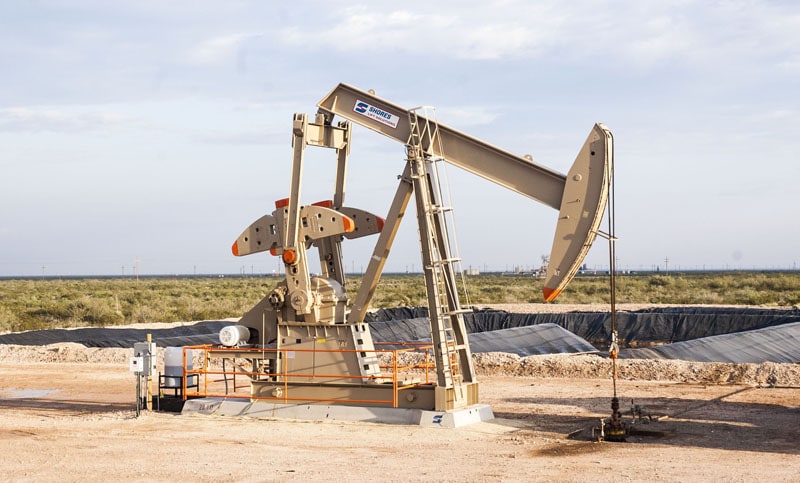
What If the Well Uses a Pumpjack?
Now the troubleshooting becomes different.
A pumpjack moving up and down does not prove that oil is reaching the surface.
The surface unit is only part of the pumping system.
A conventional rod pumped well includes equipment extending thousands of feet underground.
The surface pumping unit moves the rod string.
The rods operate a downhole pump.
A problem anywhere in that system can affect production.
The Pumpjack Can Be Running While the Well Produces Nothing
This surprises people.
You can watch the horsehead moving and assume everything is working.
But perhaps a rod has parted.
Perhaps the downhole pump is not filling properly.
Perhaps a valve in the pump is not functioning.
Perhaps the pump is gas interfering.
Perhaps the fluid level has fallen too low.
Perhaps there is a tubing problem.
The visible motion at the surface only tells you that the surface unit is moving.
It does not prove the entire pumping system is doing useful work.
What Is a Pump Off Condition?
A rod pump needs liquid available at its intake.
Imagine the pump is capable of moving liquid faster than the reservoir can supply it.
The fluid level in the well begins falling.
Eventually the pump barrel may not completely fill during each cycle.
The pump is now operating inefficiently.
This is commonly associated with a pumped off condition.
Running the pump faster does not necessarily solve the problem.
If reservoir inflow is the limitation, increasing pump speed can make the condition worse.
This is why pumping speed and runtime are matched to the well’s ability to deliver fluid.
Why Do Some Pumpjacks Stop and Start Automatically?
Because many wells do not need to pump continuously.
Suppose the reservoir supplies 100 barrels of liquid per day, but the pumping system could theoretically move considerably more.
Running twenty four hours a day may simply pump the fluid level down and waste energy.
A controller can allow the well to build fluid and then operate the pumping unit according to the selected strategy.
Modern rod pumped wells may use pump off controllers and other automation to optimize operation.
A stopped pumpjack therefore does not automatically mean the well is broken.
It may be intentionally waiting.
How Do Operators Know What a Downhole Rod Pump Is Doing?
They cannot simply look through the tubing.
Instead, they use indirect measurements.
One important tool is the dynamometer.
A dynamometer measures load behavior through the pumping cycle.
The resulting information can be displayed as a dynamometer card.
To someone unfamiliar with rod pumping, the card may look like an odd geometric shape.
To an experienced production engineer or technician, its shape can provide clues about what is happening downhole.
Pump fillage.
Gas interference.
Valve problems.
Mechanical friction.
Rod loading.
Other abnormal conditions.
This is a good example of how surface measurements can reveal conditions thousands of feet underground.
What If a Rod Breaks?
Rod strings experience repeated loading.
Every pumping cycle creates another cycle of stress.
Multiply that by thousands of cycles.
Then by months.
Then by years.
Corrosion, wear, loading, well geometry, and operating conditions can all influence rod life.
If a rod parts, the surface unit may no longer be effectively connected to the downhole pump.
Repair usually requires a well service operation to retrieve and replace the affected equipment.
A broken rod is not fixed by restarting the pumpjack.
What If the Tubing Has a Hole?
The tubing is supposed to carry produced fluid toward the surface.
If it develops a leak, some of that fluid may escape into the annulus instead.
Production at the surface can decrease.
Pressure behavior may change.
The artificial lift system may appear to be working harder without delivering the expected fluid.
Tubing leaks can result from corrosion, wear, mechanical damage, or other causes.
Confirming the problem may require pressure testing or other diagnostic work.
Once confirmed, repairing it generally means pulling or otherwise intervening in the tubing.
What If the Well Uses an ESP?
An electric submersible pump creates a completely different troubleshooting problem.
The pump and motor are installed downhole.
Electrical power is supplied from the surface.
If the well suddenly stops producing, operators and engineers can examine electrical and operating information.
Did the motor trip?
What happened to current?
What happened to voltage?
Did intake pressure change?
Did temperature increase?
Was there evidence of gas interference?
Did the variable speed drive report a fault?
A modern ESP system can provide a considerable amount of information before anyone decides to pull the equipment.
That matters because replacing an ESP can be expensive.
Why Do ESPs Trip?
There is no single answer.
Potential causes can involve electrical faults, motor loading, overheating, gas, solids, changes in fluid supply, power quality, surface equipment, or protective settings.
The trip is sometimes the protection system doing exactly what it was designed to do.
Repeatedly resetting a tripped system without understanding the cause can turn a manageable problem into a damaged pump or motor.
A trip is information.
Treat it that way.
What If the Well Is on Gas Lift?
A gas lift well depends on injected gas helping reduce the effective density of the fluid column inside the tubing.
If the lift gas disappears, production can decrease or stop.
Troubleshooting may therefore include checking injection pressure and rate.
Is the compressor running?
Is the injection control valve operating?
Is the gas actually reaching the well?
Has casing pressure changed?
Are the expected gas lift valves operating as intended?
A problem at a compressor facility kilometres away can therefore cause an individual well to stop producing.
The well itself may be perfectly healthy.
The Facility Can Shut the Well Down Too
Sometimes there is nothing wrong with the well.
The downstream facility cannot accept production.
Suppose the production separator is at high level.
Or a storage tank is full.
Or a compressor is unavailable.
Or a pipeline has shut down.
Or a processing plant downstream has stopped accepting gas.
The facility may automatically shut wells in to prevent unsafe conditions.
From the well’s perspective, production has stopped.
From the operator’s perspective, the cause is somewhere completely different.
This is why oil and gas production is a system.
You cannot troubleshoot every problem by standing at the wellhead.
What Is a High High Level Shutdown?
Production equipment uses protective instrumentation.
Consider a separator.
If liquid level becomes too high, the normal level control should respond.
If that fails and the level continues rising, another independent high level condition may trigger an alarm or shutdown.
At a sufficiently serious condition, incoming production can be stopped.
That may mean closing shutdown valves at the facility or shutting in wells upstream.
Production stops, but that is preferable to filling equipment beyond safe operating limits.
Many shutdowns that appear inconvenient are actually protection systems preventing a much larger problem.
What About Low Temperature?
Cold weather creates its own collection of production problems.
Water can freeze.
Hydrates can form under suitable gas conditions.
Instrument lines can freeze.
Pneumatic equipment can have problems.
Valves can become difficult to operate.
Batteries can struggle.
Viscous oil becomes harder to move.
A well that behaves perfectly during summer may become much more difficult during extreme winter conditions.
This is why operators in cold producing regions spend significant time winterizing equipment before the temperature drops.
Could the Reservoir Simply Be Depleted?
Yes.
Eventually reservoir pressure and productive capacity decline.
But depletion usually produces a trend rather than an instantaneous transition from strong production to nothing.
The well may gradually make less oil.
Fluid levels may change.
Water cut may increase.
Gas production may change.
Artificial lift requirements may increase.
A sudden overnight loss therefore encourages operators to first look for something that changed suddenly.
A gradual long term decline encourages a different investigation.
What Is Inflow?
Inflow describes fluids moving from the reservoir into the well.
Every producing well has some relationship between pressure and the amount of fluid the reservoir can deliver.
If the pressure inside the well is reduced, inflow may increase.
But only to a point.
Reservoir permeability, pressure, fluid properties, completion effectiveness, and formation damage all influence what the well can deliver.
Artificial lift cannot create oil in the reservoir.
It helps create pressure conditions that allow available fluids to enter and travel up the well.
Formation Damage Can Reduce Production
The rock immediately around the well is particularly important because all produced fluids have to pass through that region.
If permeability near the well becomes reduced, production can fall even when plenty of hydrocarbons remain farther into the reservoir.
Several mechanisms can contribute to formation damage depending on the well.
Scale.
Fines.
Solids.
Fluid incompatibility.
Completion damage.
Deposits.
Changes in saturation.
The exact treatment depends on the cause.
This is why pumping a random chemical down a poorly producing well is not a troubleshooting strategy.
Diagnose first.
Treat second.
Perforations Can Become Restricted
In a cased and cemented completion, perforations provide flow paths through the casing and cement into the reservoir.
Those flow paths can become impaired.
Scale can contribute.
Solids can contribute.
Formation damage can occur near the perforations.
If enough flow capacity is lost, well production declines.
Various stimulation or remediation methods may be considered depending on the reservoir and cause.
Again, the first job is identifying what is actually limiting production.
Sometimes the Well Needs Stimulation
If reservoir inflow has become restricted, operators may consider stimulation.
Acid treatments are used in certain formations and damage situations.
Hydraulic fracturing can create additional flow paths in suitable reservoirs.
Other treatments may target specific deposits or restrictions.
Stimulation is not simply a way to “wake up” any poor well.
The treatment has to address the actual limitation.
A well with a broken rod does not need acid.
A well with a plugged flowline does not need hydraulic fracturing.
A good diagnosis prevents expensive wrong answers.
Why Production History Matters
Suppose a well normally produces 100 barrels per day.
Then production declines:
98
95
91
86
80
That pattern tells a story.
Now compare it with:
100
101
99
100
0
That tells a very different story.
Production engineers spend significant time looking at trends because the shape of the problem helps identify its cause.
Pressure trends matter.
Fluid level trends matter.
Water cut trends matter.
Gas oil ratio trends matter.
Artificial lift performance matters.
A single data point is useful.
A year of data is much more useful.
What Is a Well Test?
In facilities where several wells produce into common equipment, operators need a way to determine what each individual well is contributing.
A well test temporarily measures production from a particular well.
Depending on the facility, the test may determine oil, water, and gas production.
This information helps identify declining wells.
Without individual well testing, total field production might decrease while nobody immediately knows which well caused the loss.
Accurate testing is therefore fundamental to production optimization.
Sometimes the Well Is Producing More Water, Not Less Fluid
Imagine yesterday’s well test showed:
300 barrels of oil
100 barrels of water
Today the well produces:
150 barrels of oil
300 barrels of water
Total liquid actually increased.
Oil production did not.
This distinction matters.
A production problem may not involve loss of total inflow.
The reservoir may simply be delivering a different fluid mixture.
As fields mature, increasing water production becomes one of the major challenges.
The well is still producing.
It is just producing less of the fluid you are being paid for.
Gas Can Create Similar Confusion
A well’s gas oil ratio can change over time.
Increasing gas production can affect artificial lift, separators, compressors, and facility capacity.
A well producing large quantities of gas may be limited not by its oil potential but by how much gas the facility can handle.
Production optimization therefore involves more than maximizing one well.
The best operating point for the field may require restricting some wells so the entire gathering and processing system remains within capacity.
Why Not Send a Workover Rig Immediately?
Because interventions cost money.
Before mobilizing equipment, engineers want evidence that the intervention will address the actual problem.
Imagine spending a large amount of money pulling tubing only to discover that the real problem was a plugged surface choke.
That is why troubleshooting usually progresses from the simplest and least expensive checks toward more complicated possibilities.
Verify measurements.
Check surface equipment.
Review operating changes.
Analyze artificial lift.
Examine pressure behavior.
Run diagnostics if necessary.
Then decide whether intervention is justified.
What Is a Workover?
A workover is a significant intervention performed on an existing well to repair, modify, or restore it.
The operation can involve pulling tubing.
Replacing downhole equipment.
Repairing artificial lift.
Changing the completion.
Addressing casing problems.
Treating the formation.
Performing other substantial well work.
A workover can restore valuable production.
It can also cost enough that the economics need careful evaluation.
Not Every Dead Well Should Be Fixed
This is the business side of production engineering.
Suppose a failed well could be repaired for $500,000.
The technical team believes the repair will restore 20 barrels per day.
Should the company do it?
Maybe.
Maybe not.
You need to estimate future production.
Oil price.
Operating costs.
Decline.
Water disposal costs.
Taxes and royalties.
Probability of success.
Remaining well life.
Alternative uses for the same capital.
A technically repairable well is not automatically an economically repairable well.
Sometimes the Best Decision Is Abandonment
Every well eventually reaches the end of its economic life.
At some point, the expected value of future production no longer justifies continued operating and repair costs.
The well can then be permanently plugged and abandoned according to applicable requirements.
That does not necessarily mean the reservoir contains absolutely no oil.
It means recovering the remaining oil from that particular well is no longer economically justified under the expected conditions.
This distinction appears throughout the petroleum industry.
Resources can exist underground without being commercially recoverable.
How Experienced Operators Approach a Dead Well
They usually do not begin by guessing the most complicated failure imaginable.
They ask questions.
Is the production measurement correct?
Is the well intentionally shut in?
Are the valves lined up correctly?
What are tubing and casing pressures doing?
What is flowline pressure?
Is the artificial lift system operating?
Did anything trip?
Did anything change before production stopped?
Is the downstream facility accepting production?
Are other wells experiencing the same problem?
Is there evidence of a restriction?
Is there evidence of a downhole failure?
Each answer narrows the search.
That is the essence of troubleshooting.
The Most Important Skill Is Knowing What Normal Looks Like
A pressure of 250 psi means very little by itself.
If the well normally operates at 245 psi, it may be perfectly ordinary.
If the well normally operates at 60 psi, 250 psi deserves attention.
The same applies to motor current.
Pump fillage.
Casing pressure.
Flowline temperature.
Water cut.
Gas rate.
Chemical usage.
Operators who know their wells notice changes before the computer necessarily identifies them as failures.
That experience is difficult to replace.
A good operator does not simply know how to restart equipment.
They know when restarting it is the wrong thing to do.
Frequently Asked Questions
Why would an oil well suddenly stop producing?
Possible causes include artificial lift failure, closed or failed valves, plugged chokes or flowlines, electrical problems, facility shutdowns, instrumentation problems, tubing failures, scale, wax, hydrates, sand, or changes in reservoir inflow.
Does a stopped oil well mean it has run out of oil?
Usually not if production stopped suddenly. Reservoir depletion normally creates a longer term decline. A sudden loss of production often indicates an operational, mechanical, or flow problem.
Can a pumpjack move without producing oil?
Yes. The surface pumping unit can continue moving even when a downhole rod, pump, tubing, fluid supply, or other component has a problem.
Why does an oil well pump only part of the day?
Some wells can deliver fluid from the reservoir more slowly than the pumping equipment can remove it. Intermittent operation or pump control can help match the pumping system to reservoir inflow.
Can an oil pipeline become plugged?
Yes. Depending on the fluids and conditions, restrictions can involve wax, scale, hydrates, sand, debris, frozen water, valves, or other mechanical problems.
What is the first thing an operator checks when a well stops producing?
The exact procedure depends on the facility, but confirming that the production loss is real and reviewing surface conditions, pressures, valve positions, artificial lift status, alarms, and recent operational changes are logical early steps.
Can a well start producing again after being dead?
Yes. If the problem can be identified and economically corrected, production may be restored through repairs, cleanouts, artificial lift work, stimulation, surface maintenance, or other interventions.
What is the difference between a workover and normal maintenance?
Normal maintenance generally addresses routine surface equipment and operating needs. A workover is a more significant well intervention that can involve tubing, downhole equipment, the completion, or the producing formation.
Why would an oil company leave oil underground instead of repairing a well?
Because recovery has to be economic. If the expected value of future production is lower than the cost and risk of repairing and operating the well, plugging and abandoning it may make more financial sense.
Who decides how to fix a poorly producing well?
It is usually a team effort involving field operators, production engineers, artificial lift specialists, maintenance personnel, well intervention teams, reservoir engineers, and other specialists depending on the problem.