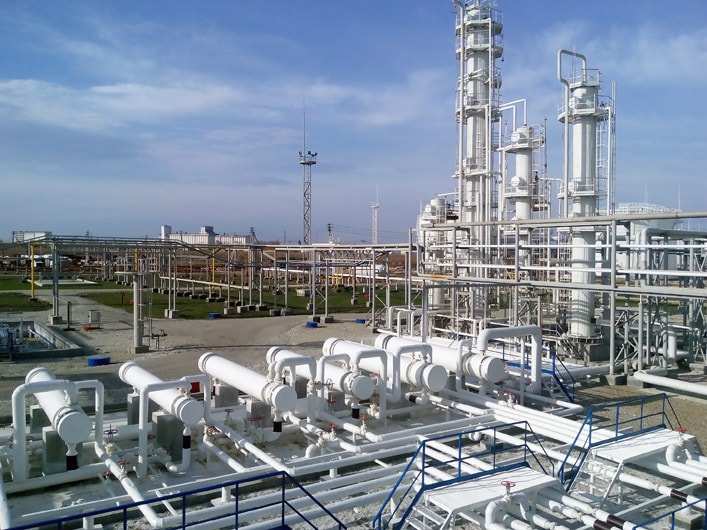
An operator walks up to a natural gas regulator on a warm day and finds ice covering the valve.
The air temperature might be well above freezing.
The upstream gas might also be warm.
Yet the piping immediately downstream of the pressure reduction can become cold enough for water to freeze.
This surprises people the first time they see it.
The reason is the Joule Thomson effect.
When natural gas experiences a large pressure reduction through a choke, regulator, control valve, or similar restriction, its temperature usually falls.
Sometimes the temperature change is small.
Sometimes it is large enough to create ice, hydrates, liquid condensation, frozen instruments, and serious operating problems.
The same effect can also be intentionally used in natural gas processing to cool gas and recover hydrocarbon liquids.
Understanding why natural gas gets cold when pressure drops helps explain several things operators see every day.
It explains why regulators freeze.
It explains why line heaters are installed before large pressure reductions.
It explains why hydrates form around chokes.
It explains why condensate can suddenly appear downstream of a valve.
And it explains how some gas processing plants intentionally use pressure to create refrigeration.
What Is the Joule Thomson Effect?
The Joule Thomson effect describes the temperature change of a real gas when its pressure is reduced through a restriction under approximately constant enthalpy conditions.
That restriction might be a valve, regulator, choke, or porous material.
For most natural gas mixtures at ordinary oil and gas operating temperatures, reducing pressure causes the gas temperature to decrease.
This is often called Joule Thomson cooling.
Operators may simply call it JT cooling.
The concept becomes extremely important anywhere high pressure natural gas is reduced to a much lower pressure.
Why Does Natural Gas Cool When Pressure Drops?
Natural gas is not a perfectly ideal gas.
Its molecules interact with one another.
When pressure changes, the balance between molecular energy and these interactions changes.
During throttling through a valve, the result for typical natural gas conditions is usually a decrease in temperature.
You do not need a deep thermodynamics background to work with the effect in the field.
The practical relationship is more important.
Large gas pressure reduction can create large temperature reduction.
The greater the pressure cut, the more attention operators and engineers need to give to downstream temperature.
Does Every Gas Always Get Colder When Pressure Drops?
No.
The direction and magnitude of the Joule Thomson temperature change depend on the gas composition, starting pressure, and starting temperature.
Certain gases under particular conditions can actually warm during throttling.
Hydrogen and helium are well known examples under some common conditions.
Natural gas at typical production and pipeline conditions normally cools when pressure is reduced.
That is why JT cooling is such an important practical issue in gas operations.
How Much Can Natural Gas Temperature Drop?
There is no universal number because natural gas composition and operating conditions vary.
However, a rough field estimate sometimes used for ordinary natural gas conditions is around 6 to 8 degrees Fahrenheit of cooling for every 100 psi of pressure reduction.
This is only an approximation.
Real calculations use the actual gas composition, pressure, temperature, and thermodynamic properties.
But the rough estimate shows how significant the effect can become.
A 100 psi pressure drop may produce only modest cooling.
A 1,000 psi pressure reduction can create an enormous temperature change.
A Simple Example of JT Cooling
Imagine natural gas reaches a production facility at 1,200 psi and 80 degrees Fahrenheit.
The gas passes through a pressure control valve and leaves at 300 psi.
That is a 900 psi pressure reduction.
Using a rough estimate of 7 degrees Fahrenheit of cooling per 100 psi, the theoretical temperature reduction could be around 63 degrees Fahrenheit.
The gas could therefore leave the pressure reduction near 17 degrees Fahrenheit under those simplified assumptions.
That is well below the freezing point of water.
Actual temperature would depend on gas composition and heat transferred from the surrounding equipment.
But the example explains why ice can appear even when outdoor weather is relatively warm.
Why Can a Gas Regulator Freeze on a Warm Day?
Because outdoor air temperature is not what creates most of the cooling.
The cooling occurs inside the gas stream as pressure is reduced.
Imagine a gas regulator operating on a 75 degree Fahrenheit summer afternoon.
High pressure gas enters the regulator.
Pressure falls dramatically across the internal restriction.
The gas temperature may fall below freezing.
Moisture then freezes around the coldest areas.
The outside of the regulator can become covered with frost or ice even though the surrounding air feels warm.
This is not unusual in high pressure gas service.
Is the Ice Always Coming From Water Inside the Gas?
Not necessarily.
The cold metal surface can also cause moisture from surrounding air to condense and freeze externally.
That creates visible frost.
Internal freezing is more serious.
If free water or water vapor in the gas forms ice inside a small passage, flow can become restricted.
Natural gas can also form gas hydrates, which are different from ordinary ice.
Both problems are associated with cold gas, but they are not exactly the same thing.
What Is the Difference Between Ice and Gas Hydrate?
Ordinary ice is frozen water.
Gas hydrate is a solid crystalline structure containing water molecules and gas molecules.
Under suitable pressure and temperature conditions, water and natural gas can combine to form hydrate crystals.
These solids can resemble ice.
But hydrates can form at temperatures above the normal freezing point of pure water when pressure is high enough.
This makes hydrates particularly important in natural gas production.
A gas line does not need to reach 32 degrees Fahrenheit before hydrate risk begins.
Why Are Hydrates Dangerous?
Hydrates can restrict or completely block flow.
They can form in:
Chokes
Regulators
Control valves
Flowlines
Instrument connections
Meters
Separators
Wellheads
Pipelines
A small restriction is particularly vulnerable because pressure reduction and cooling occur in the same area.
Once hydrate begins forming, the reduced flow area can make the operating problem worse.
A valve that was controlling normally can eventually become partially or completely plugged.
Why Are Chokes Common Hydrate Locations?
A choke intentionally creates pressure drop.
High pressure well fluids enter one side.
Lower pressure fluids leave the other.
That makes the choke one of the coldest points in many production systems.
If the gas contains enough water and the operating conditions enter the hydrate formation region, solids can develop around the choke trim or downstream piping.
Operators may see decreasing flow, unstable pressure, or complete blockage.
High pressure gas wells with large pressure reductions can be especially vulnerable.
Why Are Natural Gas Regulators Common Freezing Locations?
A regulator automatically reduces pressure to maintain a desired downstream condition.
The regulator restriction continuously creates pressure drop while gas flows.
That means JT cooling is continuously occurring there.
If upstream pressure is high and downstream pressure is much lower, the cooling can become substantial.
Water content then determines whether that low temperature simply makes the pipe cold or creates an actual freezing problem.
Why Does Water Content Matter So Much?
Dry gas is much less likely to create water related freezing problems than wet gas.
Raw natural gas from a well can contain significant water vapor.
It may also contain free liquid water.
When pressure and temperature change, water can condense.
Once liquid water exists, hydrate formation becomes more likely when pressure and temperature conditions are suitable.
This is one reason gas dehydration is so important.
Removing water does more than meet a pipeline specification.
It also reduces the risk of hydrate and corrosion problems downstream.
Can Dehydrated Gas Still Get Cold?
Yes.
Dehydration does not eliminate the Joule Thomson effect.
The gas still cools when pressure is reduced.
What changes is the amount of water available to freeze or form hydrates.
A properly dehydrated gas stream can pass through a large pressure reduction and become extremely cold without developing the same water related problems as wet gas.
Equipment materials and low temperature limits still need to be considered.
Cold gas can create other concerns even when no ice forms.
Why Is There Sometimes Liquid Downstream of a Pressure Reducing Valve?
Cooling can cause hydrocarbons to condense.
Natural gas often contains heavier hydrocarbons such as ethane, propane, butanes, pentanes, and heavier components.
At high temperature and pressure, some of these components may remain in the gas phase.
After the pressure reduction, JT cooling lowers temperature.
The new pressure and temperature conditions may move part of the mixture into the liquid region.
Condensate then forms.
This is one reason a gas stream that appears completely dry upstream can produce liquid downstream of a valve.
Can Water Also Condense After Pressure Reduction?
Yes.
Natural gas can contain water vapor even when no free water is visible.
Cooling reduces the amount of water vapor the gas can retain under many operating conditions.
If the gas reaches its water dew point, liquid water begins condensing.
Now the system contains cold gas and free water.
That combination can create hydrate or ice problems.
A pressure reduction can therefore create the very liquid that later causes the restriction.
What Is Hydrocarbon Dew Point?
Hydrocarbon dew point is the condition at which heavier hydrocarbon components begin condensing from a gas mixture.
Pipeline gas normally has limits designed to reduce the risk of excessive liquid formation during transportation.
If gas is cooled below its hydrocarbon dew point, condensate can form.
JT cooling can drive gas toward or through that condition.
Gas processors can use this intentionally.
Operators can also encounter it unexpectedly.
How Is JT Cooling Used Intentionally in Gas Processing?
Natural gas plants can use pressure reduction as a refrigeration method.
High pressure gas is cooled and then expanded through a Joule Thomson valve.
The pressure reduction creates additional cooling.
Heavier hydrocarbons condense.
A separator then removes the resulting liquid.
The remaining gas can be reheated or processed further before entering the sales system.
This type of arrangement can recover valuable natural gas liquids without requiring the same equipment used in more complex cryogenic processes.
What Is a JT Plant?
A Joule Thomson gas plant uses gas pressure reduction as an important part of the cooling process used to recover hydrocarbon liquids.
The basic sequence can include:
Gas pretreatment
Heat exchange
Pressure reduction
Cooling
Low temperature separation
Gas reheating
The incoming high pressure gas contains energy in the form of pressure.
The plant uses part of that pressure to create refrigeration.
The system works best when sufficient upstream pressure is available.
If inlet pressure declines, recovery performance can also decline.
Why Does a JT Plant Need High Inlet Pressure?
The cooling effect depends partly on having enough pressure available to remove.
Imagine two gas streams.
One enters at 1,200 psi and can be reduced to 500 psi.
The other enters at 650 psi and must also leave near 500 psi.
The first stream has much more available pressure reduction.
That allows more JT cooling.
A declining gathering system pressure can therefore reduce the refrigeration available to a JT plant.
At some point, compression or another processing method may be required to maintain performance.
How Is JT Cooling Different From Mechanical Refrigeration?
Mechanical refrigeration uses a refrigerant system with equipment such as compressors, condensers, expansion devices, and evaporators.
A JT plant uses pressure already present in the gas stream as part of the cooling process.
Mechanical refrigeration can provide cooling even when the raw gas does not have a large pressure difference available.
The two approaches can also be combined with other gas processing technologies.
The best method depends on inlet pressure, composition, required liquid recovery, product specifications, and economics.
Is a JT Valve Just a Normal Control Valve?
The operating principle is still pressure reduction through a valve.
But JT service can be demanding.
The valve may experience:
Large pressure drop
Very low temperatures
Noise
High velocity
Vibration
Liquid formation
Changing phases
Erosion
The valve and trim have to be selected for those conditions.
A valve designed for ordinary pressure control may not be suitable for severe low temperature JT service.
Why Can JT Valves Be Noisy?
A large pressure reduction releases substantial energy through a relatively small flow area.
Gas velocity can become extremely high.
Turbulence and pressure fluctuations generate noise.
Severe service control valves may use special trim designs that divide the pressure reduction into stages or distribute flow through multiple passages.
The goal is to control energy release rather than allowing the full pressure reduction to occur violently at one point.
Why Can Chokes Erode During Large Pressure Drops?
High velocity gas can carry sand, scale, liquid droplets, and other material through the choke.
These materials strike the trim at high speed.
Over time, metal is removed.
The opening becomes larger.
Flow characteristics change.
The operator may notice that the same choke setting no longer creates the same pressure or flow response.
Large pressure drop, abrasive solids, and high flow create a particularly difficult combination.
What Is a Line Heater?
A line heater adds heat to gas before a major pressure reduction.
The gas passes through heated equipment and enters the regulator or choke at a higher temperature.
JT cooling still occurs.
But because the gas began warmer, the downstream temperature remains higher.
This can reduce ice and hydrate risk.
Line heaters are common in high pressure natural gas production and pressure reduction service.
Why Heat the Gas Before the Pressure Drop?
It is often much easier to prevent freezing than to deal with a frozen valve after it occurs.
Suppose a pressure reduction is expected to lower gas temperature by 50 degrees Fahrenheit.
If gas enters the valve at 30 degrees, the downstream temperature could become extremely low.
If the gas is heated to 100 degrees first, the same pressure reduction may leave it above freezing.
The required temperature depends on the actual process and hydrate conditions.
Operators follow the approved operating range rather than simply making gas as hot as possible.
What Is a Water Bath Heater?
A water bath heater is commonly used to heat natural gas indirectly.
A burner heats a bath fluid.
Process tubing passes through that heated bath.
Heat transfers into the natural gas before it reaches the pressure reduction equipment.
The flame does not normally contact the process gas directly.
Water bath heaters are widely used at wellsites, regulator stations, and gas facilities where pressure reduction creates significant cooling.
Why Does a Heater Sometimes Have a Choke Attached to It?
The entire purpose may be to keep the choke and downstream gas warm enough to avoid freezing and hydrate formation.
High pressure gas is heated.
It then immediately passes through the choke.
Temperature falls because of JT cooling.
The heat added upstream offsets that cooling.
This arrangement is common enough that seeing a heater beside a high pressure gas choke should immediately make an operator think about pressure reduction and hydrate control.
Can You Just Insulate a Freezing Regulator?
Not always.
This is an important practical point.
If the cooling is being created inside the valve by pressure reduction, insulation does not remove the source of the cold.
In some cases, insulation can reduce heat entering from the surrounding air.
That may actually allow the equipment to remain colder.
Insulation is useful when trying to retain heat already being supplied.
It is not automatically a solution to JT cooling.
The actual cause of freezing needs to be understood first.
Why Does a Regulator Sometimes Freeze Worse After Being Insulated?
Imagine the regulator is internally cooling to 15 degrees Fahrenheit.
The outside air is 60 degrees.
Without insulation, surrounding air transfers some heat into the cold regulator.
Now wrap it in insulation.
You reduce that heat transfer.
The valve can remain closer to the internally generated cold temperature.
If no external heat source exists, insulation can sometimes work against what the operator intended.
This is why simply wrapping every frozen regulator is not a universal fix.
How Is Methanol Used for Hydrate Control?
Methanol can be injected into wet gas systems to reduce hydrate formation risk.
It mixes with water and changes the conditions under which hydrate forms.
This makes it useful during well start up, cold weather operations, high pressure gas production, and temporary hydrate problems.
Methanol does not eliminate JT cooling.
The gas still becomes cold.
The chemical changes how the available water behaves under those conditions.
Methanol handling also introduces its own safety and operating requirements.
How Is Glycol Used for Hydrate Control?
Certain glycols can also inhibit hydrate formation by interacting with water.
Monoethylene glycol is commonly associated with hydrate inhibition in suitable systems.
Triethylene glycol is more commonly associated with natural gas dehydration.
These are related but different applications.
Operators should never assume one glycol can be substituted for another without understanding the designed process.
What Is the Difference Between Preventing Hydrates and Melting a Plug?
Preventing hydrate formation is much easier.
Dehydration, chemical inhibition, heating, pressure management, and temperature control can keep the system outside dangerous hydrate conditions.
Once a solid blockage exists, the problem becomes more complicated.
Gas pressure may be trapped on one or both sides.
Hydrate plugs can move suddenly when they begin releasing.
Improvised attempts to remove them can be hazardous.
Facilities use specific procedures for hydrate remediation because stored pressure can make a plug dangerous.
Why Can Hydrates Be Dangerous Even After Flow Stops?
A hydrate plug can isolate sections of pressurized gas.
Imagine a pipeline blocked by a solid plug.
Pressure remains high upstream.
Downstream pressure may be much lower.
If the plug suddenly breaks free, the pressure difference can accelerate it through the piping.
That can create severe mechanical forces.
This is one reason hydrate removal is not simply a matter of heating a pipe until something happens.
The trapped pressure condition must be understood.
Why Do Operators Watch Temperature Downstream of a Choke?
Pressure tells only part of the story.
The temperature downstream helps indicate how much cooling is occurring and whether the system is approaching freezing or hydrate conditions.
Useful observations include:
Upstream pressure
Downstream pressure
Upstream temperature
Downstream temperature
Gas flow rate
Water production
Methanol or inhibitor rate
Heater temperature
Ambient temperature
A sudden change in any of these can shift the operating condition.
Why Can Increasing Gas Flow Make Freezing Worse?
Higher gas flow can increase the total cooling duty around a pressure reduction.
More gas is passing through the restriction.
The heater must supply enough energy to warm that larger mass of gas.
A heater that worked perfectly at a lower production rate may become inadequate after well production increases.
Operators may then see downstream temperature gradually decreasing even though heater settings have not changed.
The heater did not necessarily fail.
The load increased.
Why Can Declining Well Pressure Reduce Freezing Problems?
A producing well often begins with high pressure.
Large pressure reduction is required to bring that gas into lower pressure surface equipment.
As reservoir and wellhead pressure decline, less pressure may need to be removed across the choke.
Less pressure reduction generally means less JT cooling.
This can reduce freezing risk.
However, declining pressure creates other production problems and can eventually reduce the well’s ability to deliver gas.
Why Can a Newly Completed Gas Well Have Severe JT Cooling?
New wells can have very high flowing pressure.
The downstream production facility may operate at much lower pressure.
That creates a huge pressure cut across the choke.
The well may also be producing water and completion fluids.
Now you have the two main ingredients for freezing trouble.
Large cooling and available water.
High rate wells may also produce sand.
That creates the additional challenge of choke erosion.
Early production equipment therefore has to handle several severe conditions simultaneously.
Why Can Pressure Reduction Cause a Separator to Fill With Condensate?
Gas entering the separator may cool as pressure falls.
Heavier hydrocarbon components condense.
The separator then collects that liquid.
If gas composition or pressure conditions change, condensate production can change dramatically even if the well’s total hydrocarbon production seems similar.
Operators may sometimes think a separator has developed a level problem when the process is simply creating more liquid than before.
Understanding phase behavior helps explain what changed.
Can Ambient Temperature Affect JT Problems?
Yes.
JT cooling occurs because of the pressure reduction, but ambient temperature influences the starting condition and how much heat equipment gains from its surroundings.
A regulator operating at the edge of freezing during summer may experience much worse conditions in winter.
Gas entering from a cold buried pipeline can also start at a lower temperature.
The same pressure reduction then produces a colder outlet condition.
Cold weather therefore increases risk even though it is not the fundamental cause of the JT effect.
Why Do Gas Regulator Stations Sometimes Preheat Pipeline Gas?
Transmission and distribution systems can reduce gas from very high pipeline pressure to much lower customer or local system pressure.
Large pressure reduction can create significant JT cooling.
Preheating raises the gas temperature before the regulator.
After the gas loses temperature during pressure reduction, the final temperature remains within an acceptable operating range.
This helps prevent freezing and protects downstream equipment from temperatures below its design limits.
Can Cold Gas Damage Equipment Even Without Ice?
Yes.
Metals behave differently at low temperature.
Some materials lose toughness as temperature decreases.
Seals and elastomers can also behave differently.
Instrumentation can be affected.
Condensation may occur.
Thermal contraction can change mechanical clearances.
Process equipment therefore has minimum design temperatures.
A system does not become safe merely because no visible ice exists.
Engineers consider the lowest temperature that could reasonably occur during depressuring or throttling.
Why Does Gas Get Hot When It Is Compressed but Cold When Pressure Is Reduced?
These are different thermodynamic processes.
A compressor adds mechanical work to the gas.
That energy raises gas pressure and usually raises temperature.
A throttling valve does not operate like a compressor running backward.
Gas passes through a restriction without producing useful shaft work.
Under typical natural gas conditions, the resulting Joule Thomson effect causes cooling.
This is why compressor discharge piping can be very hot while a pressure regulator downstream can become extremely cold.
Why Are Compressor Coolers Needed If Gas Later Gets Cold Across a Valve?
Because the two processes occur at different locations for different reasons.
Compression can increase gas temperature substantially.
The gas may need to be cooled to protect downstream equipment, remove condensed liquids, improve compression efficiency between stages, or meet process requirements.
Later in the system, pressure may be reduced again.
That pressure reduction can create additional cooling.
Natural gas facilities constantly manipulate pressure and temperature because those variables strongly affect gas behavior.
Is JT Cooling the Same as Depressuring a Vessel?
Not exactly.
A vessel losing pressure can cool for several reasons.
Gas expansion, changing internal energy, vaporization of liquid, heat transfer, and other effects may all contribute.
Joule Thomson cooling specifically refers to throttling through a restriction under the appropriate conditions.
Operators sometimes use the term JT cooling broadly whenever gas pressure falls and temperature decreases.
For practical troubleshooting, it is still useful to distinguish a valve pressure reduction from the more complex cooling that can occur during vessel blowdown.
Why Can a Valve Body Become Colder Than Nearby Pipe?
The largest pressure reduction often occurs across a very small region inside the valve.
That is where the temperature change begins.
The cold gas then moves downstream and absorbs heat from the surrounding pipe and environment.
As a result, the valve body and immediate downstream piping can become much colder than equipment farther away.
The visible frost pattern can sometimes show exactly where the major pressure reduction is occurring.
Why Is Frost Sometimes Useful to an Operator?
Frost can provide a clue.
It may show where temperature is lowest.
It can reveal that gas is expanding through a particular restriction.
It may help identify an unexpected pressure reduction.
But frost should not be used as the only diagnostic tool.
A frosted valve can contain serious hydrate problems.
A valve without visible frost can still be experiencing low internal temperature.
Always use actual pressure and temperature information where available.
Why Might a Regulator Suddenly Start Freezing When It Never Did Before?
Something changed.
Possible changes include higher upstream pressure, lower downstream pressure, increased gas rate, more water in the gas, lower inlet temperature, reduced heater performance, changing gas composition, failed dehydration, or colder weather.
A regulator rarely decides to freeze for no reason.
Compare current operating conditions with the period when the system worked normally.
That comparison often reveals the cause.
Could a Bad Heater Cause Repeated Hydrate Problems?
Yes.
The heater may still be burning while transferring less heat than expected.
Possible problems include fouling, low burner output, incorrect fluid level, circulation problems, scale, control problems, fuel pressure issues, or increased process load.
Operators should look at gas temperature entering the choke rather than assuming a visible flame means the heater is doing enough work.
The important result is heat transferred into the process.
Why Does Heater Outlet Temperature Sometimes Fall When Gas Rate Increases?
The heater has limited capacity.
When more gas flows through it, the same amount of available heat is spread across a larger mass of gas.
Temperature rise per unit of gas can decrease.
The system may need more heat input to maintain the same outlet temperature.
If the burner is already near maximum output, the heater can become the production limit.
This can happen when a well is opened farther or additional wells are routed through the same equipment.
What Should an Operator Check When a Gas Valve Keeps Freezing?
Start with pressure and temperature.
How large is the pressure drop?
Has upstream pressure increased?
Has downstream pressure decreased?
What is the gas temperature before the valve?
What is the temperature afterward?
Then look at water.
Is the gas properly dehydrated?
Has water production increased?
Is a separator carrying liquid?
Is chemical inhibition working?
Then inspect the heating system.
Is the heater actually transferring enough heat?
Finally, consider the valve itself.
Is there an unusual restriction, damaged trim, or changing flow condition?
The goal is to identify why conditions entered the freezing region rather than repeatedly thawing the same equipment.
Why Is Repeated Thawing Not a Real Solution?
Thawing restores flow.
It does not necessarily remove the cause.
If high pressure wet gas is still experiencing the same pressure reduction, the equipment can freeze again.
A permanent solution addresses the operating condition.
That may involve dehydration, heating, chemical inhibition, equipment changes, pressure management, or other engineered corrections.
The correct answer depends on the system.
Can Operators Reduce the Pressure Drop Across One Valve?
Sometimes a pressure reduction can be divided across multiple stages.
Instead of removing the entire pressure difference at one point, several regulators or control stages share it.
This can reduce the severity of cooling and mechanical stress at an individual valve.
However, staged pressure reduction needs to be engineered correctly.
Adding random restrictions to piping is not a substitute for proper design.
Each stage affects temperature, pressure, capacity, and downstream conditions.
Why Does Natural Gas Processing Care So Much About Pressure?
Pressure is more than something the pipe has to contain.
It is process energy.
High pressure can move gas through pipelines.
It can drive gas through equipment.
It can improve certain separation conditions.
And through JT expansion, it can provide refrigeration.
When a gas plant reduces pressure, some of that useful pressure energy is being consumed.
Good process design tries to use that pressure intelligently.
Why Should New Oil and Gas Workers Understand JT Cooling?
Because it explains a surprising amount of field behavior.
It explains why a choke can be covered in ice.
It explains why hydrate inhibitor is injected.
It explains why high pressure gas is heated before regulation.
It explains why liquid appears after a pressure reduction.
It explains why compressor discharge is hot.
It explains why low temperature separators exist.
And it helps workers understand that pressure and temperature in a gas system are closely connected.
Once you understand that connection, many production problems become easier to troubleshoot.
Frequently Asked Questions
What is the Joule Thomson effect?
The Joule Thomson effect is the temperature change that occurs when a real gas passes through a pressure reducing restriction under approximately constant enthalpy conditions.
Does natural gas get colder when pressure drops?
Under typical oil and gas operating conditions, yes. Natural gas normally cools when pressure is reduced through a choke, regulator, or control valve.
How much does natural gas cool when pressure drops?
The exact amount depends on composition and operating conditions. A rough field estimate sometimes used is around 6 to 8 degrees Fahrenheit for every 100 psi of pressure reduction.
Can a natural gas regulator freeze in summer?
Yes. A large pressure reduction can cool the gas below freezing even when outside temperature is warm.
Why does a gas choke freeze?
Large pressure reduction causes JT cooling. If water is present, ice or gas hydrate can form around the restriction.
What is a gas hydrate?
A gas hydrate is a crystalline solid formed from water and gas molecules under suitable pressure and temperature conditions.
Can hydrates form above 32 degrees Fahrenheit?
Yes. Under sufficient pressure, natural gas hydrates can form at temperatures above the normal freezing point of water.
Why is water dangerous in high pressure natural gas?
Water can contribute to corrosion and can form ice or hydrates when gas becomes cold.
Does dehydrating gas stop JT cooling?
No. Dehydration removes water but does not eliminate the temperature reduction caused by pressure throttling.
Why is natural gas heated before a regulator?
Heating raises the starting temperature so that the gas remains warm enough after JT cooling occurs.
What is a line heater?
A line heater transfers heat into natural gas before a pressure reduction to reduce freezing and hydrate risk.
Why can insulation make a freezing regulator worse?
If the regulator is generating its own cold condition through JT cooling, insulation can reduce heat entering from the warmer surrounding air.
Why does condensate form after a gas pressure drop?
JT cooling can lower gas temperature below its hydrocarbon dew point, causing heavier hydrocarbons to condense.
What is a JT gas plant?
A JT plant uses pressure reduction and the resulting cooling to condense and recover heavier hydrocarbons from natural gas.
Why does a JT plant need high gas pressure?
More available pressure reduction generally provides more potential cooling.
Is a JT valve different from a normal control valve?
It performs pressure control, but severe JT service can involve large pressure drops, extreme cold, noise, erosion, and multiphase flow that require suitable valve design.
Why does gas get hot when compressed?
A compressor adds mechanical energy to the gas, which normally increases temperature.
Why does the same gas become cold later through a valve?
Throttling is a different process. Under typical natural gas conditions, reducing pressure through a restriction produces Joule Thomson cooling.
Can pressure reduction create water?
It does not create water molecules, but cooling can cause water vapor already in the gas to condense into liquid.
Can pressure reduction create hydrocarbon liquid?
Yes. Cooling can cause heavier hydrocarbon components in natural gas to condense.
Why would a gas valve suddenly begin freezing after years of normal operation?
Upstream pressure, downstream pressure, gas rate, gas temperature, water content, heater performance, gas composition, or weather may have changed.
What should operators check when a regulator keeps freezing?
Check the pressure reduction, upstream and downstream temperatures, gas water content, separator performance, hydrate inhibitor system, heater performance, and valve condition.
Is repeatedly thawing a frozen valve a permanent solution?
No. If the pressure, temperature, and water conditions remain unchanged, the freezing or hydrate problem is likely to return.
What is the most important thing to remember about JT cooling?
Pressure and temperature in natural gas systems are connected.
When high pressure gas passes through a major restriction, the temperature can fall dramatically.
Once you understand that relationship, frozen regulators, hydrate problems, line heaters, condensate formation, and low temperature gas processing all become much easier to understand.