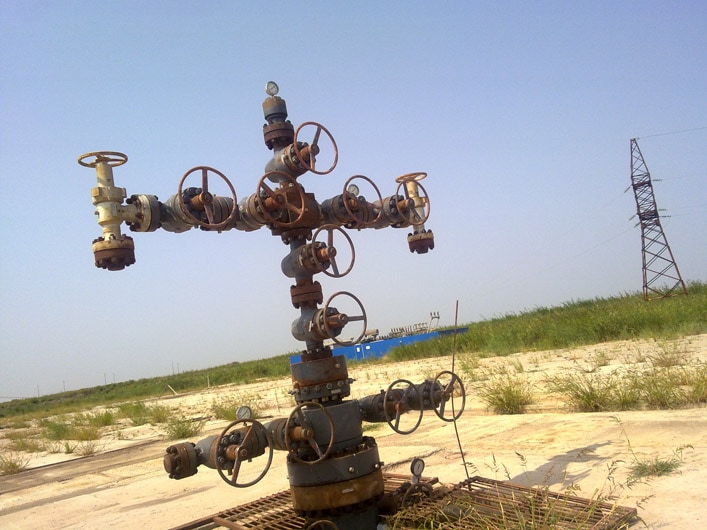
Walk up to a producing oil or gas well and you may see several pressure gauges around the wellhead.
One might show tubing pressure.
Another might show casing pressure.
Depending on the completion, there may be additional pressures being monitored as well.
For someone new to production operations, the obvious question is:
Why does one well need several pressure readings?
They are all connected to the same well, so shouldn’t they show roughly the same pressure?
Not necessarily.
Tubing pressure and casing pressure are measurements from different parts of the well. The relationship between them can tell an experienced operator a surprising amount about what is happening thousands of feet underground.
Understanding those pressures is one of the fundamentals of oil and gas production.
Start With the Basic Well Construction
To understand the pressure readings, picture the well as several pipes inside one another.
The larger steel pipe installed in the well is called casing.
Inside that casing is usually a smaller pipe called production tubing.
Produced fluids commonly travel toward the surface through the tubing.
The space between the tubing and casing is called the annulus.
That gives us two separate areas where pressure can be measured.
Tubing pressure measures pressure associated with the tubing.
Casing pressure usually refers to pressure in the annular space outside the production tubing and inside the casing.
The exact meaning depends on how the well is completed and operated, so the first rule is never to interpret a pressure reading without understanding the well configuration. This point also comes up repeatedly in field discussions about tubing and casing pressure. (Reddit)
What Is Tubing Pressure?
Tubing pressure is normally measured at the surface near the tubing side of the wellhead.
If the well is producing through tubing, this is the pressure of the production stream as it reaches the surface.
That stream may contain:
Oil
Natural gas
Produced water
Or all three at the same time
Tubing pressure is influenced by what is happening both underground and at the surface.
A producing well has to overcome several things before fluids can reach the production facility.
There is the weight of the fluid column.
There is friction inside the tubing.
There is pressure in the flowline and separator downstream.
There may also be a choke restricting flow at the wellhead.
So tubing pressure is not simply reservoir pressure appearing on a gauge.
It is one measurement within a much larger pressure system.
What Is Casing Pressure?
On many completed wells, casing pressure is a measurement of pressure in the annulus between the tubing and casing.
What that pressure represents depends heavily on the well.
For example, the annulus may contain gas.
It may be used as part of a gas lift system.
It may communicate with fluids lower in the well.
It may be intentionally isolated.
Different completion designs produce very different pressure behavior.
This is why statements such as “casing pressure should always be higher than tubing pressure” are unreliable.
You need to know how the well is configured.
Why Are Tubing and Casing Pressure Different?
Imagine two columns extending thousands of feet underground.
One contains the producing fluid moving through the tubing.
The other is the annular space surrounding it.
They may contain fluids of different densities.
They may be connected to different parts of the completion.
One may be flowing while the other is static.
One may be receiving injected gas.
They therefore do not have to show the same surface pressure.
In fact, the difference between them can be extremely useful.
Operators often look at pressure trends rather than treating each gauge as an isolated number.
Pressure Is Not the Same Everywhere in the Well
Suppose the tubing gauge shows 150 psi at the surface.
That does not mean pressure is 150 psi all the way down to the producing formation.
Pressure increases as you travel deeper through a column of fluid because of the fluid’s weight.
This is hydrostatic pressure.
A well that is several thousand feet deep can therefore have a much greater pressure near the bottom than what you see on the surface gauge.
Friction also changes pressure while fluids are moving.
For this reason, engineers distinguish between several pressures, including surface pressure and bottom hole pressure. Estimating bottom hole pressure from surface measurements requires accounting for the fluid column and other well conditions. (Reddit)
Flowline Pressure Matters Too
A producing well does not discharge into an empty pipe.
It usually sends fluids through a flowline toward equipment such as a separator, production battery, gathering system, or processing facility.
That downstream system already has pressure.
The well needs enough energy to overcome it.
Suppose a well has 200 psi of tubing pressure and the flowline is operating at 150 psi.
There is a pressure difference available to move fluids toward the facility.
Now imagine flowline pressure rises significantly.
The well may produce less because it is pushing against greater backpressure.
This is one reason production operators should understand the entire system rather than focusing only on the wellhead.
What Does a Choke Do?
Many flowing wells have a choke near the wellhead.
A choke creates a controlled restriction.
By changing the choke opening, operators can influence the flow rate and pressure behavior of the well.
Closing the choke further usually creates more restriction.
Opening it reduces restriction.
That does not mean operators should simply open every choke completely to maximize production.
Producing a well too aggressively can create other problems depending on the reservoir and completion.
Production rates are selected for technical and economic reasons, not simply by opening the largest possible flow path.
Why Is Casing Pressure Important on a Pumping Well?
Consider a conventional oil well using a rod pump and pumpjack.
The pump is located underground.
Produced liquid enters the pump and is lifted through the tubing toward the surface.
Gas can be present in the casing annulus.
If casing pressure changes significantly, it can affect conditions around the pump and the pressure the reservoir is producing against.
Operators therefore watch casing pressure along with production rates and fluid levels.
A pressure change does not automatically mean something is wrong.
But an unusual pressure change compared with the well’s normal behavior deserves attention.
High Casing Pressure Does Not Have One Cause
Suppose casing pressure is normally 60 psi.
Today it is 180 psi.
What happened?
There is no universal answer.
The correct response is not to immediately start turning valves.
First determine why the pressure changed.
Possible explanations can involve changing gas production, flow restrictions, artificial lift operation, changes in fluid level, well configuration, equipment issues, or another operating condition.
The trend matters.
The history matters.
The completion matters.
A pressure number without context is just a number.
What Is Gas Lock?
Gas can create problems in some pumping wells.
A downhole pump is designed primarily to move liquid.
If too much free gas enters certain pumps, the pump may compress and expand gas rather than efficiently moving liquid.
Production can fall.
This is commonly referred to as gas interference or, in some situations, gas lock.
Field operators sometimes connect unexpected casing pressure behavior with pump performance problems, but the diagnosis depends on the specific well. Discussions among production workers illustrate how casing gas and pump behavior can interact in actual troubleshooting. (Reddit)
It is not something that should be diagnosed from one pressure gauge alone.
Gas Lift Makes Casing Pressure Even More Interesting
Gas lift wells operate differently from conventional rod pumped wells.
In many gas lift designs, compressed gas is injected down the annulus.
That gas eventually enters the tubing through gas lift equipment installed downhole.
Once inside the tubing, it mixes with produced fluids.
The gas reduces the average density of the fluid column, which helps the well produce.
In this configuration, casing pressure may be strongly influenced by the gas injection system.
Tubing pressure reflects conditions on the production side.
Comparing the two becomes part of understanding whether the gas lift system is operating correctly.
This is another reason you cannot interpret casing pressure without knowing the artificial lift method.
Why Does Gas Help Lift Liquid?
Imagine trying to lift a pipe completely filled with heavy liquid.
Now imagine that much of the liquid column contains gas bubbles.
The second mixture weighs less.
The reservoir therefore has less hydrostatic pressure to overcome.
That is the basic idea behind gas lift.
It does not pull oil out of the reservoir.
Instead, it changes the pressure conditions inside the production tubing so fluids can move toward the surface more easily.
What Happens When a Well Is Shut In?
When a producing well is shut in, flow stops.
Pressure then begins moving toward a new equilibrium.
Tubing pressure may rise.
Casing pressure may change.
The speed and magnitude of those changes depend on the well.
Engineers can learn valuable information from shut in pressure behavior because flowing friction is no longer affecting the well in the same way.
However, surface pressure still needs to be interpreted together with the fluid column and well configuration.
Flowing Pressure and Shut In Pressure Are Not the Same
This distinction is important.
A flowing well is using reservoir energy to move fluids.
That movement creates pressure losses.
When the well is shut in, flow stops.
Pressure can build.
Therefore, telling someone that a well has “500 psi pressure” is incomplete.
Is that flowing tubing pressure?
Shut in tubing pressure?
Casing pressure?
Separator pressure?
Pressure measured where?
Under what operating condition?
Experienced production personnel learn to ask these questions before drawing conclusions.
Why Do Operators Record Pressures Every Day?
Modern wells can send pressure data automatically to a central system.
Historically, operators often recorded readings manually.
Either way, the real value is not the individual number.
It is the trend.
Imagine the following tubing pressure readings:
Monday: 225 psi
Tuesday: 222 psi
Wednesday: 220 psi
Thursday: 218 psi
That may simply reflect normal well behavior.
Now imagine:
Monday: 225 psi
Tuesday: 224 psi
Wednesday: 223 psi
Thursday: 75 psi
Something changed.
The pressure trend gives the operator a reason to investigate.
Production operations are full of situations where small changes noticed early prevent much larger problems later.
Pressure Can Help Identify Restrictions
Suppose pressure upstream of a piece of equipment rises while pressure downstream falls.
That may indicate increasing restriction between the two measurement points.
This principle is used throughout oil and gas facilities.
Pressure differences can help operators identify problems involving valves, filters, strainers, piping, chokes, and other equipment.
The same basic reasoning appears in field instrumentation discussions where pressure is monitored on opposite sides of equipment to detect restrictions. (Reddit)
The important skill is not memorizing what one pressure is supposed to be.
It is understanding what the pressures are telling you about flow.
Can Tubing Pressure Be Zero?
It can be low under certain circumstances, but context matters.
A well may be shut down.
It may have been depressurized.
Instrumentation may be isolated.
The well may operate under conditions where surface tubing pressure is very low.
Or the gauge may simply be faulty.
Never assume that a gauge reading of zero means there is no pressure anywhere in the system.
This is a critical safety principle.
A zero gauge reading is not proof that equipment is safe to open.
Isolation and verification procedures exist for a reason.
Can Casing Pressure Be Zero?
Again, it depends on the completion and operating condition.
Some annuli may normally have little or no surface pressure.
Others may intentionally operate under pressure.
Gas lift wells are an obvious example where annular pressure can be part of normal operation.
Unexpected pressure where none should exist can also require investigation.
The well design determines what is normal.
Why Is Unexpected Annular Pressure Taken Seriously?
Pressure appearing in an annulus can sometimes indicate communication between areas that are intended to remain isolated.
Possible causes can involve tubing, packers, casing, cement, completion equipment, thermal effects, or trapped fluids.
This does not mean every casing pressure reading indicates a leak.
Far from it.
But unexplained pressure behavior can be important because well barriers are part of maintaining long term well integrity. Industry literature treats casing and annular pressure as an important well integrity issue that requires evaluation based on the specific well and operating condition. (ScienceDirect)
A Tubing Leak Can Change Pressure Behavior
Production tubing operates for years in a difficult environment.
It may be exposed to corrosion, scale, pressure cycles, temperature changes, and mechanical stresses.
If tubing develops a leak, fluids can communicate between the tubing and annulus where they normally would not.
That can alter pressure behavior.
Operators may notice unusual relationships between tubing and casing pressure, changes in production, or other symptoms.
Confirming a tubing leak requires proper testing.
One gauge reading alone is not enough.
What Is a Packer?
Many wells contain a downhole device called a packer.
A packer creates a seal between the production tubing and casing.
It helps isolate the annulus from the producing zone and allows the tubing to function as the intended production path.
If the completion includes a packer, the pressure above and below it becomes part of understanding the well.
Packer integrity therefore matters when evaluating unexpected annular pressure.
Surface Pressure Does Not Tell You Everything
This is probably the most important lesson.
Imagine two wells.
Both have 200 psi tubing pressure at the surface.
Are they operating identically?
Not even close.
One might be 3,000 feet deep.
The other might be 12,000 feet deep.
One might produce mostly oil.
The other might produce mostly gas.
One might have a high water cut.
One might be on gas lift.
One might produce through a large tubing string.
The other might have a smaller tubing string.
The same surface pressure can represent very different downhole conditions.
Why Experienced Operators Know Their Wells
A new operator sees a pressure of 110 psi.
An experienced operator may immediately think:
“That well normally runs around 70.”
That is the advantage of knowing the history.
Production wells develop recognizable patterns.
Operators become familiar with normal pressures, production rates, fluid levels, chemical consumption, artificial lift behavior, and equipment sounds.
When one of those patterns changes, it deserves attention.
This is why automation has not removed the need for knowledgeable field operators.
Data becomes much more useful when someone understands what normal looks like.
Pressure Gauges Can Lie
Never forget the instrument itself.
A pressure gauge can fail.
A pressure transmitter can drift.
A sensing line can plug.
A valve between the process and instrument may be closed.
The reading displayed on a computer may not represent actual process conditions.
When a pressure reading makes no sense, one of the possibilities is always an instrumentation problem.
That does not mean you should assume every strange reading is a bad instrument.
It means you verify.
Good troubleshooting separates what you know from what you think you know.
Do Not Bleed Pressure Just Because It Looks High
Someone new to production might see unusually high casing pressure and assume the obvious solution is to release it.
That can be dangerous.
Pressure exists for a reason.
Before manipulating a pressurized well, operators need to understand the well configuration, operating procedure, destination of any released fluids, and consequences of changing the pressure.
Gas may contain hydrogen sulfide.
Hydrocarbons are flammable.
Changing casing pressure can affect downhole behavior.
Follow the approved operating procedure rather than treating a producing well like a tire that needs a little air released.
Tubing Pressure, Casing Pressure, and Production Should Be Looked at Together
One reading becomes much more useful when compared with others.
Suppose oil production declines.
At the same time, tubing pressure changes.
Casing pressure changes too.
Now you have several clues.
Add fluid level information.
Artificial lift data.
Separator pressure.
Flowline pressure.
Recent maintenance history.
Suddenly a much clearer picture begins to form.
This is essentially what production troubleshooting is.
You collect evidence and narrow down the possibilities.
Frequently Asked Questions
What is the difference between tubing pressure and casing pressure?
Tubing pressure measures pressure associated with the production tubing. Casing pressure generally refers to pressure in an annular space associated with the casing. Their exact meanings depend on the well completion and operating configuration.
Should casing pressure be higher than tubing pressure?
Not necessarily. The relationship depends on how the well is completed, whether it is flowing, the fluids present, artificial lift method, downstream pressure, and other operating conditions.
Why does tubing pressure increase when a well is shut in?
When flow stops, pressure losses associated with moving fluids are reduced and pressure can build toward a static condition. The amount of pressure increase depends on the reservoir and well.
Does high casing pressure mean the well has a problem?
Not automatically. Some wells normally operate with casing pressure, particularly certain artificial lift systems. Unexpected changes from established normal behavior are more useful than simply deciding that one pressure number is high.
What is annulus pressure?
Annulus pressure is pressure within the space between two concentric tubular strings. In a common production completion, this can mean the space between production tubing and casing.
Is tubing pressure the same as reservoir pressure?
No. Tubing pressure at the surface is influenced by the fluid column, friction, flow rate, well depth, choke conditions, and downstream pressure. Reservoir pressure exists underground and requires additional information or measurements to determine.
Why do operators monitor casing and tubing pressure?
Pressure trends help operators understand well performance, identify changing operating conditions, evaluate artificial lift performance, and recognize potential equipment or well integrity problems.
Can a bad pressure gauge make a well look like it has a problem?
Yes. Gauges, transmitters, sensing lines, and isolation valves can all create misleading readings. Unusual measurements should be verified before conclusions are made.