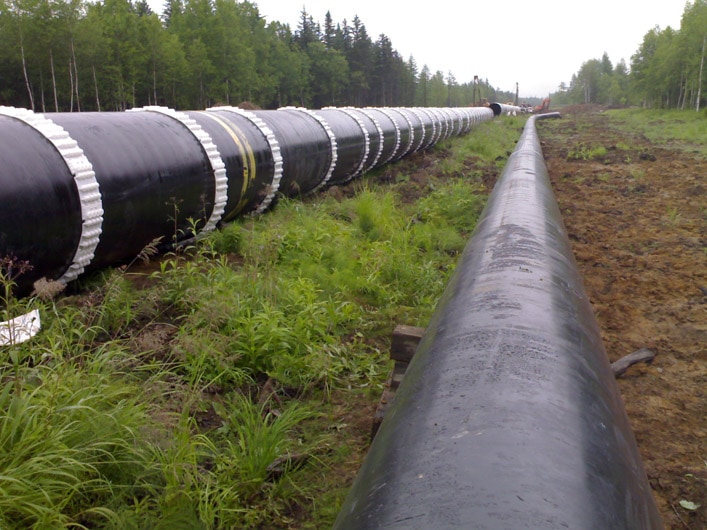
Flow rate tells you how much fluid moves through a pipe.
Velocity tells you how fast that fluid is moving.
Those are not the same thing.
A pipeline carrying 10,000 barrels per day through a 4 inch pipe has a much higher liquid velocity than a pipeline carrying the same volume through a 12 inch pipe.
That difference affects pressure loss, erosion, noise, equipment sizing, liquid handling, and the behavior of multiphase flow.
Velocity calculations are also useful for checking whether a flow rate makes sense.
If a calculation produces an extremely high velocity through a small line, the issue may not be the velocity equation. The assumed flow rate, pipe diameter, or operating condition may be wrong.
The basic equation is simple:
Velocity = volumetric flow rate ÷ flow area
Most of the work involves getting the units right.
What Is Fluid Velocity?
Fluid velocity is the average speed at which fluid moves through the cross sectional area of a pipe.
In US oilfield calculations, velocity is commonly expressed in:
Feet per second
In metric calculations, it is commonly expressed in:
Meters per second
Velocity should not be confused with volumetric flow rate.
For example:
1,000 barrels per day is a flow rate.
5 feet per second is a velocity.
The two are connected through pipe area.
What Is the Basic Flow Velocity Equation?
The fundamental equation is:
Q = A × V
Where:
Q = volumetric flow rate
A = internal cross sectional flow area
V = average velocity
Rearranging:
V = Q ÷ A
This relationship works for liquids and gases as long as the volumetric flow rate and area are expressed in compatible units.
How Do You Calculate Pipe Area?
For a circular pipe:
Area = π × D² ÷ 4
Where:
D = internal pipe diameter
Use the actual internal diameter when accuracy matters.
Nominal pipe size is not necessarily the same as internal diameter.
Why Does Internal Diameter Matter?
Fluid flows through the space inside the pipe.
The outside diameter does not determine the available flow area.
Wall thickness reduces the internal diameter.
Two pipes with the same nominal size can therefore have different internal areas if their wall thicknesses differ.
Because area depends on diameter squared, even a relatively small change in internal diameter can noticeably affect velocity.
What Is the Oilfield Formula for Liquid Velocity From Barrels Per Day?
A convenient approximation for liquid flow is:
Velocity in feet per second = 0.0119 × barrels per day ÷ ID²
Where:
ID = internal pipe diameter in inches
This equation combines the normal unit conversions into one constant.
It is useful for quick field estimates.
Where Does the 0.0119 Constant Come From?
Start with:
Velocity = flow ÷ area
One barrel contains:
42 US gallons
One cubic foot contains approximately:
7.4805 gallons
One day contains:
86,400 seconds
The pipe area must also be converted from square inches to square feet.
Combining these conversions produces the approximate field constant.
Understanding the original equation is more important than memorizing the constant because the original relationship works with any consistent unit system.
Example: Calculate Velocity for 1,000 Barrels Per Day in a 4 Inch Line
Suppose:
Flow = 1,000 barrels per day
Internal diameter = 4 inches
Use:
Velocity = 0.0119 × 1,000 ÷ 4²
First square the diameter:
4² = 16
Then:
Velocity = 11.9 ÷ 16
Velocity = approximately 0.74 feet per second
So the average liquid velocity is about:
0.74 feet per second
Example: Calculate Velocity for 10,000 Barrels Per Day in a 4 Inch Line
Keep the same pipe but increase the rate:
Flow = 10,000 barrels per day
ID = 4 inches
Velocity:
0.0119 × 10,000 ÷ 16
Velocity = approximately 7.44 feet per second
Increasing flow by a factor of ten increased velocity by the same factor because pipe area did not change.
What Happens If the Pipe Diameter Doubles?
Area depends on diameter squared.
Suppose diameter doubles from 4 inches to 8 inches.
A 4 inch diameter gives:
4² = 16
An 8 inch diameter gives:
8² = 64
The second pipe has four times the approximate internal area.
At the same flow rate, velocity becomes roughly one quarter as large.
This square relationship explains why increasing pipe diameter can dramatically reduce velocity.
Example: 10,000 Barrels Per Day Through an 8 Inch Line
Use:
Velocity = 0.0119 × 10,000 ÷ 8²
8² = 64
Velocity:
119 ÷ 64 = approximately 1.86 feet per second
Compare that with the 4 inch example:
4 inch line = approximately 7.44 feet per second
8 inch line = approximately 1.86 feet per second
Same liquid rate.
Very different velocity.
Why Does Higher Velocity Increase Pressure Loss?
Fluid moving through a pipe experiences friction.
As velocity increases, friction losses generally increase strongly.
The exact relationship depends on flow regime, pipe roughness, fluid properties, diameter, and the pressure loss equation being used.
But the practical result is straightforward.
Trying to force more fluid through a small pipe usually requires more pressure.
At some point, increasing pump pressure becomes inefficient or impractical.
Can a Pipeline Have High Pressure and Low Velocity?
Yes.
Pressure and velocity are related through the overall hydraulic system, but high pressure does not automatically mean high velocity.
A blocked line can have high pressure and almost no flow.
A large transmission pipeline can operate at substantial pressure while maintaining moderate velocity.
A small line can have relatively low pressure while fluid moves quickly.
Never use pressure alone as a substitute for measuring or calculating flow.
Can a Pipeline Have High Velocity and Low Pressure?
Yes.
For example, fluid discharging through a restriction can reach high velocity while static pressure falls.
Gas systems commonly show strong pressure and velocity changes through:
Chokes
Control valves
Orifices
Nozzles
Restrictions
The relationship depends on how pressure energy is converted and lost through the system.
How Do You Calculate Flow Rate If Velocity Is Known?
Start with:
Q = A × V
For a circular pipe:
Q = π × D² ÷ 4 × V
Make sure diameter is expressed in units compatible with velocity.
If diameter is in feet and velocity is in feet per second, the result is cubic feet per second.
That result can then be converted into barrels per day, gallons per minute, or another desired unit.
What Is the Approximate Formula for Barrels Per Day From Velocity?
Rearrange the field velocity equation:
Velocity = 0.0119 × BPD ÷ ID²
Therefore:
BPD = Velocity × ID² ÷ 0.0119
This is useful when you know a desired velocity and want to estimate the corresponding liquid rate.
Example: How Many Barrels Per Day Flow at 5 Feet Per Second Through a 6 Inch Pipe?
Suppose:
Velocity = 5 feet per second
ID = 6 inches
Use:
BPD = 5 × 6² ÷ 0.0119
6² = 36
5 × 36 = 180
180 ÷ 0.0119 = approximately 15,126 barrels per day
So a 6 inch internal diameter line moving liquid at 5 feet per second carries roughly:
15,100 barrels per day
How Do You Convert Barrels Per Day to Gallons Per Minute?
One barrel contains:
42 gallons
One day contains:
1,440 minutes
Therefore:
GPM = BPD × 42 ÷ 1,440
This simplifies to approximately:
GPM = BPD × 0.02917
For example:
1,000 barrels per day × 0.02917 = approximately 29.2 gallons per minute
How Do You Convert Gallons Per Minute to Barrels Per Day?
Reverse the calculation:
BPD = GPM × 1,440 ÷ 42
This simplifies to:
BPD = GPM × approximately 34.29
For example:
100 gallons per minute × 34.29 = approximately 3,429 barrels per day
How Do You Calculate Velocity From Gallons Per Minute?
A common water and liquid flow relationship is:
Velocity in feet per second = 0.4085 × GPM ÷ ID²
Where:
ID = internal diameter in inches
For example:
Flow = 500 gallons per minute
ID = 8 inches
Velocity:
0.4085 × 500 ÷ 64
Velocity = approximately 3.19 feet per second
Why Do the GPM and BPD Equations Look Different?
They describe the same physical relationship.
Only the flow units are different.
One equation expects gallons per minute.
The other expects barrels per day.
The constants handle the unit conversion.
If everything is converted correctly, both methods give the same answer.
How Do You Calculate Velocity in Metric Units?
The basic equation remains:
V = Q ÷ A
Suppose:
Flow = cubic meters per second
Diameter = meters
Then:
Area = π × D² ÷ 4
Velocity = Q ÷ area
The result is meters per second.
No special oilfield constant is required if the units are already consistent.
Example: Calculate Velocity From Cubic Meters Per Hour
Suppose:
Flow = 100 cubic meters per hour
Pipe ID = 0.15 meter
First convert flow to cubic meters per second:
100 ÷ 3,600 = approximately 0.02778 cubic meters per second
Calculate pipe area:
Area = 3.1416 × 0.15² ÷ 4
Area = approximately 0.01767 square meter
Now calculate velocity:
0.02778 ÷ 0.01767 = approximately 1.57 meters per second
So the average velocity is approximately:
1.57 meters per second
How Do You Convert Feet Per Second to Meters Per Second?
Use:
Meters per second = feet per second × 0.3048
For example:
10 feet per second × 0.3048 = 3.048 meters per second
To convert meters per second to feet per second:
Feet per second = meters per second ÷ 0.3048
Why Is Velocity Important for Erosion?
High velocity can increase the energy carried by fluid and any entrained solids or droplets.
This becomes particularly important when the stream contains:
Sand
Scale
Produced solids
Liquid droplets in gas
Corrosion products
Particles striking elbows, tees, chokes, and other direction changes can remove material from the pipe wall.
The most vulnerable location is not always a long straight section.
Geometry matters.
Why Are Elbows Often Vulnerable to Erosion?
Fluid changes direction through an elbow.
Particles have momentum and may not follow the gas or liquid streamlines perfectly.
They can strike the outer portion of the bend.
Repeated impact can remove metal.
This is why sand producing wells can create severe erosion in:
Elbows
Chokes
Tees
Wellhead equipment
Flowline fittings
High velocity increases concern, but solids concentration and particle characteristics also matter.
Is There One Maximum Safe Velocity for Every Oil Pipeline?
No.
A universal velocity limit would ignore too many variables.
Acceptable velocity depends on factors such as:
Fluid properties
Sand production
Corrosion
Pipe material
Pressure
Temperature
Flow regime
Water content
Gas content
Noise
Vibration
Equipment limitations
Company design standards
A velocity that is acceptable in clean treated water may be inappropriate in a sand laden multiphase wellstream.
Can Velocity Be Too Low?
Yes.
Higher velocity is not always bad, and lower velocity is not always good.
Low velocity can create its own problems.
Solids may settle.
Water can accumulate.
Wax deposition can become more troublesome under some conditions.
Liquids can collect in low points of gas pipelines.
Multiphase flow can become unstable.
The desired velocity therefore depends on what the system needs to accomplish.
Why Can Low Velocity Cause Sand to Settle?
Moving fluid exerts forces on particles.
If velocity becomes too low, the flow may no longer transport larger or denser particles effectively.
They begin settling.
Deposited solids reduce the available flow area.
That can eventually increase pressure loss and create restrictions.
A line designed to carry produced sand therefore needs more than a simple maximum velocity check.
Minimum transport conditions can matter too.
Why Does Low Gas Velocity Allow Liquid to Accumulate?
Gas pipelines can contain water or hydrocarbon condensate.
If gas velocity is insufficient to carry those liquids forward, they collect in low sections of the pipeline.
This increases liquid holdup.
As gas pressure builds behind accumulated liquid, the liquid may eventually move as a slug.
The result can be unstable downstream flow.
What Is Superficial Velocity?
Superficial velocity is widely used in multiphase flow calculations.
It is the velocity one phase would have if it alone occupied the entire pipe cross sectional area.
For gas:
Superficial gas velocity = gas volumetric flow ÷ total pipe area
For liquid:
Superficial liquid velocity = liquid volumetric flow ÷ total pipe area
These are calculated velocities rather than necessarily the actual velocity of each phase.
Why Use Superficial Velocity?
In multiphase flow, gas and liquid share the pipe.
The actual area occupied by each phase changes continuously.
That makes direct phase velocity difficult to describe.
Superficial velocity provides a convenient reference.
Engineers use superficial gas and liquid velocities when analyzing:
Flow regimes
Pressure drop
Liquid holdup
Slugging
Erosion
Separator inlet conditions
Multiphase correlations
Example: Calculate Superficial Liquid Velocity
Suppose a pipeline carries:
2,000 barrels of liquid per day
Internal diameter = 4 inches
Use the same liquid velocity equation:
Velocity = 0.0119 × 2,000 ÷ 16
Velocity = approximately 1.49 feet per second
If gas is also flowing through the pipe, 1.49 feet per second represents the superficial liquid velocity because the calculation assumes the liquid alone occupies the entire pipe area.
The actual liquid velocity can be different.
What Is Actual Phase Velocity?
Actual phase velocity accounts for the fraction of pipe area occupied by that phase.
Suppose liquid occupies only part of the pipe.
The liquid still has to carry its flow through that smaller area.
Its actual average velocity can therefore be higher than its superficial velocity.
Similarly, gas may travel faster than liquid.
This difference creates slip between the phases.
What Is Slip Velocity?
Slip occurs when gas and liquid move at different velocities.
Gas often moves faster than liquid.
This is one reason gas volume fraction does not automatically equal the fraction of pipe area occupied by gas.
Multiphase flow becomes considerably more complicated than single phase flow because the phases interact.
Why Is Gas Velocity Harder to Calculate?
Gas is compressible.
Its actual volumetric flow changes as pressure and temperature change.
Suppose a gas stream is reported as:
5 MMSCFD
That is a standard flow rate.
The pipe does not physically contain gas at standard conditions unless it actually operates at those conditions.
To calculate pipeline gas velocity, the standard flow must first be converted to actual flow at the local pressure and temperature.
Can You Use SCFM Directly to Calculate Pipeline Velocity?
Not usually.
If the pipeline is operating at elevated pressure, SCFM does not represent the physical volume passing through the pipe each minute.
You need actual cubic feet per minute at the local conditions.
Then:
Gas velocity = ACFM ÷ pipe area
Using standard volume directly can produce an enormous error.
Example: Why Standard Gas Flow Cannot Be Used Directly
Suppose gas flow is:
1,000 SCFM
The pipeline operates at approximately:
100 psig
If someone treats 1,000 SCFM as 1,000 actual cubic feet per minute, the calculated velocity will be much too high.
At elevated pressure, the gas occupies a smaller actual volume.
The correct actual volume depends on:
Absolute pressure
Absolute temperature
Compressibility factor
Standard conditions
Only after that conversion should velocity be calculated.
How Do You Calculate Gas Velocity From ACFM?
First calculate pipe area in square feet.
If internal diameter is in inches:
Diameter in feet = diameter in inches ÷ 12
Then:
Area = π × diameter² ÷ 4
Convert ACFM to actual cubic feet per second:
Actual cubic feet per second = ACFM ÷ 60
Finally:
Velocity = actual cubic feet per second ÷ pipe area
Example: Calculate Gas Velocity in a 6 Inch Line
Suppose:
Actual gas flow = 500 ACFM
Pipe ID = 6 inches
Convert diameter:
6 ÷ 12 = 0.5 foot
Area:
3.1416 × 0.5² ÷ 4 = approximately 0.19635 square foot
Convert flow:
500 ÷ 60 = approximately 8.333 cubic feet per second
Velocity:
8.333 ÷ 0.19635 = approximately 42.4 feet per second
So the average gas velocity is approximately:
42 feet per second
Why Are Gas Velocities Often Higher Than Liquid Velocities?
Gas density is much lower than liquid density.
Gas systems can therefore operate at much higher volumetric velocities while carrying relatively modest mass.
However, high gas velocity can create:
Noise
Vibration
Pressure loss
Erosion
Liquid entrainment
Equipment limitations
The acceptable range depends on the service.
What Is Erosional Velocity?
Erosional velocity is a concept used to evaluate whether fluid velocity may create excessive erosion risk.
A commonly recognized relationship has the general form:
Erosional velocity = C ÷ √density
Where:
C = an empirical factor
Density = fluid mixture density
The exact application requires engineering judgment.
It should not be treated as a universal rule that guarantees a pipe is safe below one calculated number.
Why Should the Erosional Velocity Equation Be Used Carefully?
Actual erosion depends on much more than bulk fluid density.
Important factors include:
Sand concentration
Particle size
Particle shape
Liquid droplets
Corrosion
Pipe geometry
Material
Flow regime
Velocity changes
Impact angle
Operating history
A calculated threshold can be useful for screening, but field conditions still matter.
Why Does Sand Make Velocity More Important?
Clean fluid can flow through a pipe for years without severe erosion under conditions where sand laden fluid could damage fittings quickly.
Sand particles carry kinetic energy.
Higher particle velocity increases impact severity.
If production suddenly begins carrying sand, an operating velocity that was previously acceptable may deserve renewed attention.
How Does Pipe Restriction Affect Velocity?
If the same volumetric flow is forced through a smaller area, velocity increases.
Suppose scale reduces the effective internal diameter.
The line may still carry similar production initially.
But the remaining opening has less area.
Velocity through the restriction rises.
Pressure loss also increases.
This can create a feedback problem as deposition continues.
Why Does Diameter Have Such a Strong Effect?
Because area depends on diameter squared.
Consider a reduction from:
4 inches
to:
3 inches
The diameter decreased by 25 percent.
But compare the squared values:
4² = 16
3² = 9
The available area is only about 56 percent of the original area.
For the same volumetric flow, velocity becomes much higher.
Small diameter changes are more important than they first appear.
Can Velocity Help Identify a Bad Flow Reading?
Yes.
Suppose an instrument reports an extremely large flow through a very small line.
Calculate the implied velocity.
If the answer is physically unreasonable for the service, investigate the measurement.
Possible problems include:
Wrong units
Incorrect meter scaling
Bad transmitter data
Wrong pipe diameter
Standard gas volume confused with actual gas volume
Decimal error
Incorrect time basis
Velocity is a useful sanity check.
What Is Reynolds Number?
Reynolds number helps describe whether flow is dominated more by viscous forces or inertial forces.
The general equation is:
Re = density × velocity × diameter ÷ viscosity
It can also be written using kinematic viscosity.
Reynolds number is dimensionless.
It is widely used in pipe flow calculations because flow behavior changes as Reynolds number changes.
What Is Laminar Flow?
Laminar flow is relatively orderly flow where fluid moves in layers.
In a circular pipe, it generally occurs at low Reynolds number.
Viscous forces are important.
The velocity profile across the pipe is strongly curved, with maximum velocity near the center and zero velocity at the wall.
What Is Turbulent Flow?
Turbulent flow contains significant mixing and fluctuating motion.
Most high rate oil and gas pipeline operations are turbulent.
Pressure loss behavior in turbulent flow depends on factors including:
Velocity
Pipe diameter
Density
Viscosity
Pipe roughness
Turbulence improves mixing but also contributes to frictional energy loss.
Does Average Velocity Mean Every Molecule Moves at That Speed?
No.
The velocity equation gives an average across the pipe.
Fluid next to the wall moves more slowly because of the no slip condition.
Fluid nearer the center can move faster than the average.
The exact velocity profile depends on the flow regime.
For most field calculations, average velocity is the useful value.
How Is Velocity Related to Pressure Drop?
Increasing velocity generally increases frictional pressure loss.
For many turbulent flow situations, frictional pressure drop has a strong relationship with velocity squared.
This means doubling velocity can increase friction losses by much more than double.
The exact result depends on the complete hydraulic system.
This is why pushing slightly more production through an already constrained line can require a surprisingly large pressure increase.
Why Can a Larger Pipeline Reduce Pumping Cost?
A larger internal diameter reduces velocity at the same flow.
Lower velocity generally reduces friction loss.
The pump then requires less differential pressure to move the fluid.
However, larger pipe costs more to purchase and install.
Pipeline design therefore involves balancing:
Capital cost
Operating cost
Expected flow
Future capacity
Pressure limits
Fluid behavior
There is no single best diameter for every service.
How Can Velocity Affect a Separator?
The inlet line determines how quickly the wellstream enters the separator.
High inlet velocity can create significant momentum.
The inlet device must dissipate that momentum and distribute the phases.
Poor inlet conditions can contribute to:
Foaming
Liquid breakup
Droplet entrainment
Erosion
Unstable separation
Separator design therefore considers both flow quantity and inlet conditions.
Why Does Velocity Increase Through a Choke?
A choke reduces available flow area.
As fluid passes through the restriction, velocity rises.
Pressure falls.
The process can involve complex multiphase and compressible behavior, especially for gas wells.
The simple continuity relationship still provides useful intuition.
Smaller area means higher velocity for a given volumetric flow.
Why Do Chokes Erode?
Chokes intentionally create high velocity and pressure drop.
If the produced stream contains sand, particles pass through this severe environment.
The combination of high velocity, turbulence, and particle impact can remove material.
That is why choke condition is particularly important on sand producing wells.
Can High Velocity Cause Vibration?
Yes.
High velocity can increase turbulence and dynamic forces.
Valves, restrictions, bends, and poorly supported piping can experience vibration.
Gas systems can also develop acoustic effects.
Persistent vibration should not be dismissed as simply a noisy process.
It can contribute to fatigue failure in small bore connections, instrument tubing, supports, and other components.
How Do You Calculate Residence Time in a Pipe?
If average velocity and pipe length are known:
Time = length ÷ velocity
Suppose:
Pipe length = 5,000 feet
Average velocity = 5 feet per second
Time:
5,000 ÷ 5 = 1,000 seconds
Convert to minutes:
1,000 ÷ 60 = approximately 16.7 minutes
A fluid element would theoretically take about 17 minutes to travel that distance at the stated average velocity.
Why Is Residence Time Useful?
It can help estimate:
Chemical travel time
Displacement time
Pigging observations
Sampling delay
Temperature change
Process response time
Tracer arrival
Pipeline inventory movement
Real flow may involve mixing and dispersion, so a calculated travel time should not always be interpreted as an exact arrival time.
How Do You Calculate Pipeline Volume From Flow and Travel Time?
Rearrange:
Volume = flow rate × time
Suppose liquid flows at:
100 barrels per hour
and estimated travel time is:
5 hours
The corresponding moving volume is:
100 × 5 = 500 barrels
If the pipeline geometry predicts a very different internal volume, check the assumptions.
Can You Calculate Velocity From Pipeline Volume and Flow?
Yes.
You can first calculate residence time:
Time = pipeline volume ÷ flow rate
Then:
Velocity = pipeline length ÷ time
This should agree with the direct area based calculation when the units and assumptions are consistent.
Using two approaches can be a useful way to check your work.
Example: Complete Liquid Pipeline Calculation
Suppose:
Oil rate = 20,000 barrels per day
Pipe ID = 8 inches
Pipeline length = 10 miles
First calculate velocity:
Velocity = 0.0119 × 20,000 ÷ 64
Velocity = approximately 3.72 feet per second
Now convert pipeline length:
10 miles × 5,280 feet per mile = 52,800 feet
Calculate theoretical travel time:
52,800 ÷ 3.72 = approximately 14,194 seconds
Convert to hours:
14,194 ÷ 3,600 = approximately 3.94 hours
So the average theoretical travel time through the 10 mile pipeline is roughly four hours.
How Do You Estimate Pipeline Capacity From the Same Example?
For an 8 inch internal diameter:
Diameter in feet:
8 ÷ 12 = approximately 0.6667 foot
Area:
3.1416 × 0.6667² ÷ 4 = approximately 0.3491 square foot
Volume:
0.3491 × 52,800 = approximately 18,433 cubic feet
Convert to barrels:
18,433 ÷ 5.6146 = approximately 3,283 barrels
At:
20,000 barrels per day
the hourly rate is:
20,000 ÷ 24 = approximately 833.3 barrels per hour
Travel time:
3,283 ÷ 833.3 = approximately 3.94 hours
The result matches the velocity based calculation.
That agreement is a useful check.
Why Is Checking a Calculation Two Ways Valuable?
Unit errors are common.
If two independent methods produce approximately the same result, confidence increases.
If one method gives:
4 hours
and another gives:
40 hours
something is wrong.
Possible causes include:
Wrong diameter units
Wrong time conversion
Incorrect barrel conversion
Using radius instead of diameter
Using OD instead of ID
A misplaced decimal
Good field calculations include a reasonableness check.
What Should You Write Down Before Calculating Pipeline Velocity?
Identify:
Fluid type
Flow rate
Flow rate units
Pipe internal diameter
Whether gas flow is actual or standard
Pressure
Temperature
Required velocity units
For multiphase flow, also identify what velocity you are actually trying to calculate.
A clearly written problem is much harder to solve incorrectly.
What Is the Simplest Velocity Equation to Remember?
Remember:
Velocity = flow ÷ area
Everything else is unit conversion.
For a circular pipe:
Area = π × diameter² ÷ 4
For liquid in common oilfield units:
Velocity in feet per second = approximately 0.0119 × BPD ÷ ID²
Once you understand those relationships, you can rebuild the calculation even if you forget the field constant.
Frequently Asked Questions
How do you calculate liquid velocity in a pipeline?
Use:
Velocity = volumetric flow rate ÷ internal pipe area
The flow rate and area must use compatible units.
What is the oilfield equation for velocity from barrels per day?
A useful approximation is:
Velocity in feet per second = 0.0119 × BPD ÷ ID²
Use internal diameter in inches.
Why do you use pipe ID instead of OD?
Because fluid flows through the internal cross sectional area.
Does doubling pipe diameter cut velocity in half?
No. Since area depends on diameter squared, doubling diameter creates approximately four times the area and reduces velocity to about one quarter at the same flow.
How do you convert barrels per day to gallons per minute?
Use:
GPM = BPD × 42 ÷ 1,440
How do you convert gallons per minute to barrels per day?
Use:
BPD = GPM × 1,440 ÷ 42
Can gas flow in SCFM be used directly to calculate velocity?
Not when actual pipe conditions differ from standard conditions. Convert standard gas flow to actual volumetric flow first.
What does ACFM mean?
ACFM means actual cubic feet per minute.
Why is gas velocity affected by pressure?
Gas is compressible. Higher pressure packs the same gas quantity into a smaller actual volume.
What is superficial velocity?
It is the velocity a single phase would have if it occupied the entire pipe area by itself.
Is superficial velocity the same as actual phase velocity?
Not necessarily. In multiphase flow, each phase occupies only part of the pipe and the phases can travel at different speeds.
Why is high velocity a concern?
It can contribute to pressure loss, erosion, noise, vibration, and equipment wear.
Why can low velocity also be a problem?
Low velocity can allow sand, water, condensate, or other material to accumulate.
Does higher velocity increase pressure drop?
Generally, yes. Frictional pressure loss increases strongly as velocity rises.
Why do small restrictions create large velocity changes?
Pipe area depends on diameter squared. A modest reduction in effective diameter can therefore create a large reduction in area.
Can velocity calculations help detect bad meter readings?
Yes. Calculating the implied velocity is a useful way to determine whether a reported flow rate is physically reasonable.
How do you calculate fluid travel time through a pipeline?
Use:
Travel time = pipeline length ÷ average velocity
How do you calculate pipeline volume?
Use:
Volume = internal cross sectional area × pipeline length
Then convert the result into the desired volume unit.
What is the most common velocity calculation mistake?
Using the wrong diameter or mixing incompatible flow and area units.
What is the main equation worth remembering?
Q = A × V
From that one relationship:
V = Q ÷ A
and:
Q = A × V
Most basic pipeline velocity calculations follow from those equations.