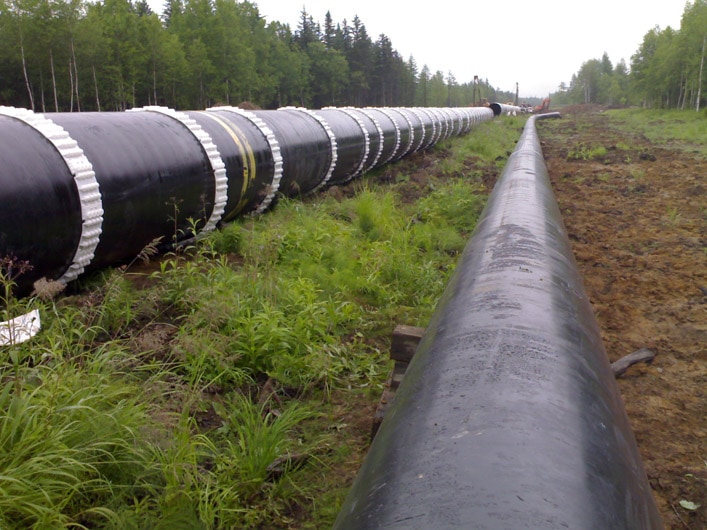
A buried steel pipeline can look completely normal from above ground while its outside wall is slowly being eaten away underground.
There may be no visible leak.
No unusual pressure.
No obvious operating problem.
But wherever steel, moisture, soil, and electrical reactions come together, corrosion can occur.
Given enough time, corrosion can reduce the thickness of a pipeline wall until the pipe can no longer safely contain pressure.
Oil and gas companies use coatings as the first major layer of protection.
But coatings are never perfect forever.
They can be damaged during construction.
They can deteriorate with age.
Small defects can develop.
This is where cathodic protection becomes important.
Cathodic protection uses electrical principles to reduce corrosion on buried or submerged steel structures.
It is widely used on oil and gas pipelines, storage tanks, well casings, marine structures, and other equipment exposed to corrosive environments.
The basic idea sounds unusual at first.
Instead of trying only to physically block corrosion, engineers deliberately control the electrical reaction that causes the steel to corrode.
Why Do Steel Pipelines Corrode?
Corrosion is an electrochemical process.
Steel contains areas that can behave slightly differently from one another.
When steel is in contact with an electrolyte such as moist soil, electrical reactions can occur.
At certain locations, iron atoms lose electrons and enter the surrounding environment as ions.
That is corrosion.
Other areas of the metal receive those electrons.
For the corrosion process to continue, there must be an electrical path and an ionic path through the surrounding environment.
A buried pipeline and moist soil can provide the conditions needed for this electrochemical cell.
Why Does Soil Cause Pipeline Corrosion?
Soil is not just dry dirt.
It can contain:
Water
Dissolved salts
Minerals
Oxygen
Bacteria
Different chemical environments
These factors influence how easily electrical current moves through the soil and how aggressively corrosion can occur.
Some soils are much more corrosive than others.
A pipeline can pass through many different soil conditions over hundreds of miles.
That means corrosion risk can change significantly along the same pipeline.
Does Steel Corrode Everywhere at the Same Rate?
No.
This is one reason corrosion can be dangerous.
Uniform corrosion would gradually reduce wall thickness over a large area.
Localized corrosion can attack a small area much more aggressively.
A pipeline that appears to have plenty of average wall thickness can still develop a deep corrosion pit.
A relatively small pit can become the weakest location in a pressurized pipeline.
Engineers therefore care about both the amount and shape of corrosion.
What Is an Anode?
In a corrosion cell, the anode is the area where metal oxidation occurs.
For steel, iron atoms can leave the metal at anodic locations.
This is where metal loss takes place.
If you want to protect a steel pipeline from corrosion, one objective is to stop the pipeline surface from behaving as the part of the system that sacrifices metal.
That leads directly to the concept of cathodic protection.
What Is a Cathode?
A cathode is the part of the electrochemical system where reduction reactions occur rather than metal oxidation.
Cathodic protection tries to make the steel structure being protected behave sufficiently cathodically.
In simple terms, electrical current is supplied in a way that reduces the tendency of the pipeline steel to dissolve.
The pipeline becomes the protected structure.
Another material or electrical system supplies the required current.
How Does Cathodic Protection Work?
Imagine a buried steel pipeline with a damaged spot in its coating.
Without additional protection, that exposed steel can corrode.
Now imagine supplying electrical current to the pipeline through the surrounding soil.
The electrical condition of the exposed steel changes.
With an appropriately designed cathodic protection system, the corrosion reaction at the pipeline surface can be greatly reduced.
There are two major ways this is commonly accomplished.
Sacrificial anode systems.
Impressed current systems.
Both protect the steel, but they produce the protective current differently.
What Is a Sacrificial Anode?
A sacrificial anode is made from a metal that is more willing to corrode than the structure being protected.
The anode is electrically connected to the steel pipeline.
The surrounding soil or water completes the electrochemical system.
Instead of the protected steel providing the main anodic metal loss, the sacrificial material gradually corrodes.
The anode is intentionally consumed.
That is why it is called sacrificial.
What Metals Are Used for Sacrificial Anodes?
Materials commonly associated with sacrificial protection include magnesium, zinc, and certain aluminum alloys.
The correct material depends on the application and environment.
A buried pipeline in soil may use a different system from an offshore structure in seawater.
Engineers consider factors such as electrical potential, environmental conditions, current demand, expected life, and installation requirements.
The anode is not simply any random piece of metal buried beside the pipeline.
Does the Sacrificial Anode Eventually Disappear?
Yes.
That is the purpose of the design.
The anode gradually gives up material while protecting the steel structure.
Eventually, its ability to provide adequate protection decreases.
Anodes therefore have a finite service life.
The system must be monitored.
If necessary, anodes can be replaced or additional protection installed.
Cathodic protection is not something that can be buried and forgotten permanently.
What Is Impressed Current Cathodic Protection?
Impressed current cathodic protection uses an external electrical power source.
Instead of relying only on the natural voltage difference between two metals, the system deliberately drives protective current onto the pipeline.
A typical system includes a power supply and anode installation.
The power source is commonly called a rectifier.
The system sends direct current through the ground from the anode system toward the pipeline.
The pipeline receives the protective current.
What Is a Cathodic Protection Rectifier?
A rectifier converts electrical power into the direct current needed by an impressed current cathodic protection system.
Operators and corrosion technicians monitor rectifier output.
Important measurements can include voltage and current.
A rectifier that stops operating can reduce protection on part of a pipeline system.
This is why rectifiers are inspected and monitored as part of pipeline integrity programs.
Modern systems may also support remote monitoring.
What Is an Anode Bed?
An impressed current system uses one or more anodes installed in the ground.
This installation is commonly called an anode bed or groundbed.
Current leaves the anodes, travels through the surrounding earth, and reaches the protected pipeline.
The current then returns through the electrical circuit.
The design of the groundbed affects how effectively current can be distributed.
Soil conditions, pipeline length, current demand, nearby structures, and electrical resistance all influence the design.
Why Not Just Connect Electricity Directly to the Pipeline?
Because cathodic protection has to be carefully controlled.
The objective is not simply to put electricity into a pipe.
Current must travel through the correct electrochemical path.
The polarity has to be correct.
The amount of current has to be appropriate.
The protected structure needs to reach suitable electrical conditions.
Nearby buried structures also need to be considered.
A poorly designed system can create new problems.
How Do Engineers Know Whether Cathodic Protection Is Working?
They measure electrical potential.
A common field measurement compares the electrical potential of the pipeline with a reference electrode placed in contact with the soil.
This is commonly called a pipe to soil potential measurement.
The reading provides information about the electrical condition of the pipeline relative to the surrounding environment.
Technicians collect these measurements at selected locations along the pipeline.
What Is a Reference Electrode?
A reference electrode provides a stable electrical reference for measuring pipeline potential.
Instead of measuring an arbitrary voltage, the technician compares the pipeline with an electrode that has known electrochemical behavior.
Different reference electrode types are used for different environments.
For buried pipelines, copper based reference electrodes are commonly encountered in field work.
The accuracy and condition of the reference electrode matter because the technician is making decisions based on relatively small voltage differences.
What Is a Cathodic Protection Test Station?
If the entire pipeline is buried, technicians need convenient places to make electrical measurements.
Test stations provide accessible connections to the pipeline and sometimes to other relevant structures or components.
They may appear above ground as small posts, boxes, or enclosures.
A technician can connect measurement equipment without excavating the pipeline.
These stations allow repeated measurements over the life of the system.
What Does a Cathodic Protection Technician Do?
A cathodic protection technician spends much of the job measuring, inspecting, troubleshooting, and documenting corrosion control systems.
Work can include:
Taking pipe to soil potential measurements
Inspecting rectifiers
Measuring current
Testing electrical continuity
Checking test stations
Investigating interference
Troubleshooting failed equipment
Participating in pipeline surveys
Maintaining records
Testing bonds between structures
Evaluating cathodic protection performance
The work combines field operations with electrical and corrosion knowledge.
Why Does Pipeline Coating Still Matter If Cathodic Protection Is Installed?
Because coating and cathodic protection work together.
The coating isolates most of the steel surface from the soil.
Cathodic protection then protects areas where the coating is damaged or ineffective.
Imagine a pipeline with excellent coating and only a few tiny defects.
The cathodic protection system only needs to supply enough current to protect those exposed areas.
Now imagine the coating has deteriorated over a large portion of the pipeline.
Much more steel is exposed.
Current demand increases significantly.
Good coating makes cathodic protection much more efficient.
What Is a Coating Holiday?
A coating holiday is a defect or discontinuity in a protective coating.
It may be extremely small.
The coating may have been damaged during handling or installation.
A defect can expose steel to the surrounding soil.
Even a small exposed area matters because corrosion can become concentrated there.
Special testing methods can be used during construction to identify coating defects before the pipeline is buried.
Why Can a Small Coating Defect Be Serious?
A small area of exposed steel can become an active corrosion site.
The surrounding coated surface may look perfect.
From above ground, there is no obvious problem.
But corrosion can continue beneath the soil at the defect.
Cathodic protection provides another layer of defense when coating is not completely intact.
This is why pipeline corrosion control is based on multiple protective measures rather than trusting one barrier.
Does Cathodic Protection Protect the Inside of a Pipeline?
Normally, external cathodic protection is intended to protect the external surface that is electrically exposed to the soil or water.
Internal corrosion is a different problem.
Inside the pipeline, corrosion can be influenced by:
Water
Carbon dioxide
Hydrogen sulfide
Oxygen
Bacteria
Deposits
Flow conditions
Internal corrosion control may require chemical treatment, dehydration, cleaning, material selection, internal coatings, monitoring, and other methods.
Protecting the outside of a pipeline does not automatically solve corrosion inside it.
Can a Pipeline Still Corrode With Cathodic Protection?
Yes.
Cathodic protection greatly reduces corrosion when properly designed, operated, and maintained.
But failures can occur.
The system may not provide enough current.
Coating can deteriorate.
Electrical continuity can be lost.
A rectifier can fail.
Shielding can prevent current from reaching certain areas.
Interference can affect the system.
Environmental conditions can change.
This is why pipeline integrity programs do not rely on cathodic protection alone.
What Is Cathodic Protection Shielding?
Protective current needs an effective path through the electrolyte to the steel surface.
Certain materials or configurations can interfere with that path.
If current cannot adequately reach exposed steel beneath a disbonded coating or another shielding material, corrosion can continue even though the overall cathodic protection system appears active.
This makes coating behavior important.
A coating that remains tightly bonded is very different from one that separates from the pipe and creates an environment where corrosion can develop underneath.
What Is a Disbonded Coating?
A disbonded coating has separated from the steel surface.
The coating may still physically cover the pipe, making the problem difficult to see.
Moisture can sometimes enter beneath the separated coating.
Depending on the coating and conditions, cathodic protection current may have difficulty reaching the steel beneath it.
That can create a hidden corrosion environment.
Pipeline integrity engineers therefore care about both coating condition and cathodic protection performance.
What Is Stray Current Corrosion?
Not all electrical current around a buried pipeline comes from its own cathodic protection system.
Current from other electrical systems can enter and leave buried metallic structures.
The location where unwanted current leaves a steel structure can experience accelerated corrosion.
This is called stray current corrosion.
Possible sources can include nearby cathodic protection systems and certain transportation or industrial electrical systems.
The problem requires careful investigation because the source may not belong to the pipeline operator experiencing the corrosion.
Can One Pipeline’s Cathodic Protection Affect Another Pipeline?
Yes.
Buried pipelines often share corridors.
One operator’s impressed current system can influence nearby metallic structures.
This is called interference.
Engineers may install electrical bonds or use other mitigation methods when required.
Operators sometimes need to coordinate with neighboring pipeline owners.
Cathodic protection therefore becomes more complicated in areas containing many buried utilities.
What Is an Electrical Bond Between Pipelines?
A bond creates a controlled electrical connection between structures.
It can be used as part of an interference mitigation strategy.
The purpose is to manage current movement rather than allowing harmful uncontrolled current discharge.
Bonds may contain resistive components or other equipment depending on the design.
They need to be monitored because changing one electrical system can affect another.
Why Are Pipelines Electrically Isolated?
Sometimes operators want different sections or facilities to remain electrically separated for corrosion control purposes.
Insulating components can prevent cathodic protection current from flowing into structures where it is not intended.
This helps define the electrical boundaries of the protected system.
But isolation needs to be maintained.
If an insulating component becomes electrically shorted, current can take a different path and reduce system performance.
What Is an Insulating Joint?
An insulating joint electrically separates sections of metallic piping while maintaining the mechanical and pressure containing connection.
It allows engineers to control where cathodic protection current flows.
Insulating components can be installed near facilities, pipeline boundaries, or other locations where electrical separation is needed.
Their condition can be tested as part of corrosion control work.
Why Are Pipeline Casings a Cathodic Protection Concern?
At some road or railway crossings, a carrier pipeline may pass through a larger casing pipe.
If the carrier pipe and casing become electrically connected when they are intended to remain isolated, cathodic protection behavior can change.
The casing can consume protective current.
The electrical condition of the carrier pipeline can become harder to interpret.
Technicians may therefore test for electrical contact between the pipeline and casing.
What Is a Close Interval Survey?
A few test stations can provide useful information, but they do not show every variation along a long pipeline.
A close interval survey collects potential measurements at much shorter spacing along the pipeline route.
This creates a detailed electrical profile.
The survey can help identify areas where protection may be inadequate or where unusual conditions exist.
Technicians may walk significant distances along the pipeline right of way while collecting measurements.
Why Is the Current Interrupted During Some Surveys?
When current flows through soil, it creates voltage effects that can influence measurements.
Engineers sometimes temporarily interrupt cathodic protection current in a synchronized manner.
Measurements taken immediately after interruption can help reduce some of these effects.
The procedure requires coordination because multiple current sources may influence the pipeline.
A survey that ignores relevant current sources can produce misleading results.
What Is a Current Attenuation Survey?
Protective current changes as it travels along a pipeline system.
Current attenuation methods can help evaluate how current is distributed.
The exact technique depends on the system and survey objective.
Corrosion specialists combine different survey methods because no single measurement reveals every possible problem.
Cathodic protection evaluation is often about building a consistent picture from several types of data.
What Is DCVG?
Direct current voltage gradient surveys are used to help locate coating defects on buried pipelines.
Protective current flowing toward exposed steel creates voltage gradients in the surrounding soil.
Special survey techniques can detect these gradients from above ground.
This allows technicians to identify areas that may warrant further investigation.
The pipeline does not necessarily have to be excavated just to search for every coating defect.
What Is ACVG?
Alternating current voltage gradient methods can also be used to locate coating defects.
The measurement approach differs from direct current methods, but the general objective is similar.
Find areas where coating condition may be poor without excavating the entire pipeline.
These surveys can help pipeline operators prioritize locations for inspection and repair.
Does Finding a Coating Defect Mean the Pipeline Is Corroded?
Not necessarily.
A coating defect creates the possibility of corrosion because steel may be exposed to the environment.
If cathodic protection has been effective, the steel at the defect may still be in good condition.
This is why engineers combine coating survey information with cathodic protection data and other integrity information.
A coating defect is a condition requiring evaluation, not automatic proof of severe metal loss.
How Is Actual Pipeline Corrosion Found?
Several methods can contribute.
Above ground surveys can identify areas of concern.
Excavations allow direct examination.
Ultrasonic equipment can measure wall thickness.
Inspection tools can travel through certain pipelines and detect metal loss.
Historical operating information is also considered.
Pipeline integrity management combines these sources rather than relying on one test.
How Do Smart Pigs Detect Corrosion?
Certain inline inspection tools use technologies designed to identify changes in the pipeline wall.
Magnetic methods are widely used for detecting metal loss.
Ultrasonic inspection is another option in suitable applications.
The inspection produces large amounts of data.
Analysts estimate the location, depth, length, and shape of metal loss features.
Locations of concern can then be excavated and physically examined.
What Happens When External Corrosion Is Found?
The response depends on severity.
A shallow area may be monitored.
Coating may be repaired.
Cathodic protection performance may be investigated.
More significant metal loss may require repair.
Operating pressure can sometimes be reduced while engineering evaluation is performed.
Severe defects can require immediate action.
The decision depends on remaining wall thickness, defect dimensions, pipe properties, pressure, location, and applicable integrity requirements.
Can Cathodic Protection Repair Existing Corrosion?
No.
Cathodic protection can reduce future electrochemical corrosion.
It does not replace steel that has already disappeared.
If a pipe wall has lost significant thickness, the structural issue still needs to be evaluated.
This distinction is important.
Corrosion control prevents or slows deterioration.
It does not reverse metal loss.
Can Too Much Cathodic Protection Be a Problem?
Yes.
More current is not automatically better.
Excessive polarization can create undesirable effects depending on the material, coating, and environment.
Some coatings can be affected.
Certain materials can be susceptible to hydrogen related problems under particular conditions.
Cathodic protection therefore has operating criteria and engineering limits.
The goal is adequate protection, not maximum possible electrical output.
Why Not Turn Every Rectifier to Maximum Output?
Because cathodic protection systems interact with the surrounding environment and other structures.
Increasing output can affect neighboring pipelines.
It can change interference conditions.
It can contribute to excessive protection in some locations while still failing to solve a local shielding problem elsewhere.
A technician adjusts systems based on measurements and engineering requirements.
The largest current number is not necessarily the best result.
Does Weather Affect Cathodic Protection?
Environmental conditions can influence measurements and current distribution.
Soil moisture changes.
Frozen ground behaves differently from wet soil.
Seasonal changes can affect soil resistance.
Water levels can change.
A reading taken under one set of conditions may differ from a reading taken months later.
This is another reason long term records are useful.
Trends often provide more information than one isolated measurement.
Why Does Soil Resistivity Matter?
Electrical current moves more easily through some soils than others.
Soil resistivity describes how strongly the soil resists electrical current flow.
Wet, salty soil may behave very differently from dry, rocky soil.
This affects anode performance and system design.
A cathodic protection system that works well in one environment may require a different configuration elsewhere.
How Long Does a Cathodic Protection System Last?
There is no universal life.
Sacrificial anodes are gradually consumed.
Impressed current anodes also have design lives.
Rectifiers and electrical components require maintenance.
Coatings age.
Pipeline conditions change.
A well maintained corrosion control system can operate for decades, but individual components may require repair or replacement during that period.
The important concept is continuous management.
Is Cathodic Protection Used Offshore?
Yes.
Seawater is an electrolyte, making corrosion control extremely important for offshore steel structures.
Cathodic protection can be used on subsea pipelines, platforms, and other submerged equipment.
Sacrificial anodes are commonly visible on offshore structures.
Impressed current systems are also used in suitable applications.
The same fundamental electrochemical principle applies even though the environment is different from buried land pipelines.
Why Do Subsea Pipelines Have Metal Blocks Attached to Them?
Those blocks may be sacrificial anodes.
They are electrically connected to the pipeline.
The anode material corrodes preferentially and supplies protective current to the steel.
Over time, the anode becomes smaller.
Engineers design the amount and distribution of anode material based on the expected current demand and service life.
What looks like an extra lump of metal can actually be a critical corrosion control component.
Is Cathodic Protection Used on Storage Tanks?
Yes.
Steel tank bottoms can be exposed to corrosive environments.
Cathodic protection may be used as part of the corrosion control strategy for certain tanks.
The design differs from a long distance pipeline because the geometry and environment are different.
The principle remains similar.
Supply protective current to steel surfaces that would otherwise be susceptible to electrochemical corrosion.
Is Cathodic Protection Used on Well Casing?
It can be.
Well casing represents a long steel structure in contact with underground environments.
External casing corrosion can be a concern in certain wells.
Cathodic protection may form part of a casing corrosion management strategy depending on well design and conditions.
Casing systems can be electrically complex because multiple strings and surface connections may be involved.
Why Is Record Keeping So Important?
Cathodic protection is a long term integrity activity.
A technician may take a reading today that looks acceptable.
Five years later, the value has changed.
Historical records help determine whether that change happened gradually or suddenly.
Rectifier output records can reveal equipment deterioration.
Survey results can reveal areas that repeatedly require attention.
Good data turns isolated measurements into trends.
Those trends can help identify problems before they become failures.
What Happens If a Rectifier Stops Working?
The pipeline does not necessarily begin leaking immediately.
Protection can decrease, however.
The seriousness depends on the system, coating condition, surrounding environment, and other current sources.
The failed rectifier needs to be identified and restored according to the operator’s procedures.
Remote monitoring can reduce the time between a failure and its discovery.
This is valuable because corrosion is a time dependent process.
Why Does Cathodic Protection Matter to Pipeline Operators?
A pipeline may remain in service for many decades.
During that entire period, the external steel needs protection.
Replacing hundreds of miles of pipeline simply because the coating has aged would be enormously expensive.
Cathodic protection provides an active way to manage external corrosion throughout the operating life.
Combined with coating, inspections, surveys, monitoring, and repairs, it becomes one part of a larger pipeline integrity system.
What Should a New Pipeline Operator Understand About Cathodic Protection?
You do not need to become a corrosion engineer to understand the basic concept.
Remember four things.
Steel can corrode when exposed to a suitable environment.
Coating separates the steel from that environment.
Coating defects eventually occur.
Cathodic protection supplies electrical protection to exposed steel where the coating alone is not enough.
If you understand those four ideas, the purpose of rectifiers, test stations, anodes, and pipe to soil measurements becomes much easier to understand.
Frequently Asked Questions
What is cathodic protection?
Cathodic protection is a corrosion control method that supplies electrical current to a metal structure so the protected steel is less likely to undergo the electrochemical reaction that causes metal loss.
Why do pipelines need cathodic protection?
Buried and submerged steel pipelines can corrode when exposed to soil or water. Cathodic protection provides an additional defense where protective coating is damaged or ineffective.
What are the two main types of cathodic protection?
The two major types are sacrificial anode systems and impressed current systems.
What is a sacrificial anode?
A sacrificial anode is a metal specifically installed so it corrodes preferentially while providing protective current to the steel structure.
Does a sacrificial anode eventually need replacement?
Yes. The anode is gradually consumed and has a finite useful life.
What is impressed current cathodic protection?
It is a system that uses an external electrical power source to drive protective direct current from an anode system through the environment and onto the protected structure.
What does a cathodic protection rectifier do?
A rectifier provides the direct current used by an impressed current cathodic protection system.
What is a pipe to soil potential?
It is an electrical measurement comparing the potential of a buried pipeline with a reference electrode in contact with the soil.
What is a cathodic protection test station?
A test station provides accessible electrical connections that technicians can use to measure and evaluate the cathodic protection system.
Does cathodic protection replace pipeline coating?
No. Coating and cathodic protection normally work together. Coating isolates most of the steel while cathodic protection helps protect exposed areas.
Does cathodic protection prevent internal pipeline corrosion?
External cathodic protection generally protects the outside surface exposed to soil or water. Internal corrosion requires separate control methods.
Can a pipeline still corrode if cathodic protection is operating?
Yes. Inadequate current, coating deterioration, shielding, electrical interference, equipment failures, and other conditions can reduce protection.
What is stray current corrosion?
Stray current corrosion can occur when unwanted electrical current enters and leaves a metallic structure. Locations where current leaves the steel can experience accelerated corrosion.
Can too much cathodic protection damage a pipeline?
Excessive protection can create undesirable effects under certain conditions. Systems are therefore operated according to engineering criteria rather than simply using the maximum possible current.
How do pipeline companies find corrosion underground?
They use combinations of cathodic protection surveys, coating surveys, inline inspection tools, excavations, ultrasonic measurements, and other integrity methods.
Can cathodic protection fix metal that has already corroded?
No. It can reduce future corrosion, but it cannot restore steel that has already been lost.
Why are sacrificial anodes attached to subsea pipelines?
The anodes corrode preferentially and provide protective current to the pipeline steel, helping reduce external corrosion in seawater.
Is cathodic protection used only on pipelines?
No. It can also be used on tanks, well casings, offshore structures, marine equipment, and other metallic structures exposed to corrosive environments.