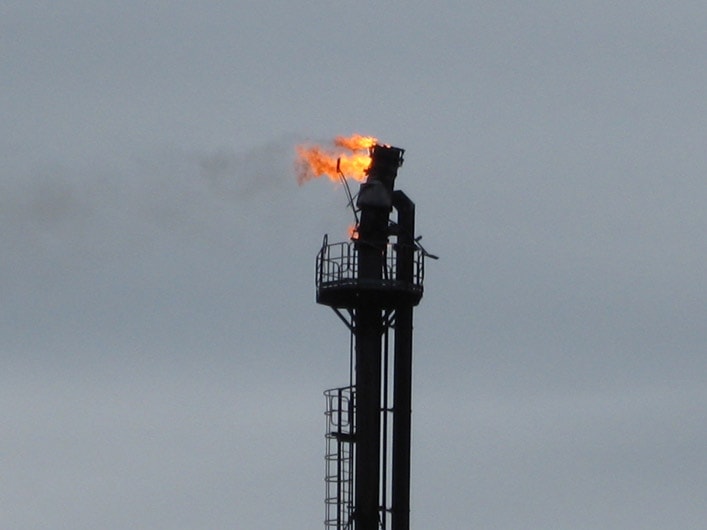
A natural gas well can have plenty of gas left in the reservoir and still stop producing.
The problem may not be reservoir depletion.
It may be water.
As a gas well gets older, its production rate usually declines. Eventually the gas may no longer move fast enough to carry the liquids entering the well to the surface.
Water begins accumulating at the bottom.
The liquid column gets taller.
Pressure against the reservoir increases.
Gas production falls even further.
More liquid accumulates.
Eventually the well can almost kill itself.
This problem is commonly called liquid loading.
It is one of the most common challenges in mature gas wells and an important reason why a well’s production rate can suddenly become unstable after years of apparently normal operation.
Where Does the Water Come From?
A gas reservoir does not necessarily contain gas alone.
Formation water may also be present.
Water can enter the well from producing intervals.
It can move into the reservoir from an aquifer.
It can appear as reservoir conditions change.
Some of the liquid found in a gas well may also be hydrocarbon condensate rather than water.
Gas carries water vapor too.
As pressure and temperature change while the gas travels toward the surface, some of that vapor can condense.
The result is that a gas well may have to continuously lift a certain amount of liquid even though gas is the product the operator actually wants.
Why Doesn’t the Water Just Flow to the Surface?
Early in the life of a strong gas well, it often does.
Gas travels upward through the production tubing at high velocity.
Liquid droplets are carried with it.
The well effectively cleans itself.
Now imagine gas production declining year after year.
Velocity inside the tubing decreases.
Eventually some liquid droplets are no longer carried all the way to the surface.
They fall back.
This is the beginning of the problem.
Gas Velocity Is Critical
Think about standing under a powerful air stream while holding small water droplets.
A strong enough air flow can carry those droplets upward.
Reduce the air velocity and gravity wins.
The droplets fall.
Something similar happens inside a gas well.
The gas needs sufficient velocity to continuously transport liquid upward.
When velocity drops below the conditions required for stable liquid removal, liquid begins accumulating.
Engineers often discuss this in terms of critical velocity.
The exact value depends on the fluid properties, pressure, tubing geometry, and other conditions.
There is no single gas rate at which every well begins loading.
Why Does Liquid Accumulate at the Bottom?
Gravity pulls the liquid downward.
If the upward gas flow cannot continuously transport it, some liquid falls back and collects in the well.
That accumulated liquid creates hydrostatic pressure.
The taller and denser the liquid column becomes, the more pressure it applies at the bottom of the well.
The reservoir now has to overcome not only surface pressure and friction but also the weight of the liquid column.
That can reduce gas inflow.
Liquid Loading Can Create a Feedback Loop
This is what makes the problem particularly troublesome.
Gas rate declines.
Gas velocity decreases.
Liquid begins accumulating.
The liquid column creates additional bottomhole pressure.
The increased bottomhole pressure reduces gas inflow.
Gas rate falls further.
Even less liquid is carried to the surface.
More liquid accumulates.
The cycle continues.
A relatively small decline in gas production can therefore push an aging well into a completely different operating condition.
What Does a Loading Gas Well Look Like?
It does not always simply stop.
Early signs can include unstable production.
The well may flow strongly for a while and then weaken.
Pressure can fluctuate.
Water production may arrive in intermittent surges.
The well may unload a large amount of liquid and temporarily improve.
Then production deteriorates again.
Operators may describe the well as heading, slugging, loading, or dying depending on the field and behavior.
The terminology varies.
The underlying problem is that the well can no longer remove liquid continuously.
What Is Heading?
A loaded gas well can sometimes cycle.
Liquid accumulates.
Pressure builds below the liquid.
Eventually enough gas pressure develops to push some of the liquid upward.
The well suddenly produces strongly.
A slug of water reaches the surface.
Bottomhole pressure decreases.
Gas production improves.
Then liquid begins accumulating again.
The cycle repeats.
This unstable behavior is often called heading.
A production trend may show repeated increases and decreases instead of a smooth gas rate.
Why Can a Well Look Better After It Blows Water?
Because removing the liquid reduces hydrostatic pressure.
Suppose hundreds of feet of liquid have accumulated in the tubing.
That liquid is effectively pushing back against the reservoir.
Once some of it reaches the surface, bottomhole pressure falls.
The pressure difference between the reservoir and the well increases.
Gas can enter more easily.
Production improves.
But unless the well can now continuously carry the remaining liquid, the improvement may be temporary.
What Is Hydrostatic Pressure?
Hydrostatic pressure is pressure created by the weight of a fluid column.
The deeper the column, the greater the pressure at the bottom.
Density matters too.
A tall column of water creates much more hydrostatic pressure than the same height of natural gas.
This is why even a relatively modest liquid volume can have a major effect in a deep gas well.
The liquid does not need to completely fill the tubing to become a problem.
Why Deep Wells Can Be Sensitive to Liquid Loading
Depth gives liquid more vertical distance over which to create hydrostatic pressure.
A deep column of water can impose substantial pressure on the producing formation.
A reservoir that once had plenty of pressure to overcome that load may struggle later in field life.
As reservoir pressure declines, the same amount of accumulated liquid becomes increasingly important.
This is one reason liquid loading often appears as gas fields mature.
How Do Engineers Know a Well Is Liquid Loading?
They look at several pieces of information together.
Gas rate.
Water rate.
Tubing pressure.
Casing pressure.
Production stability.
Well depth.
Tubing size.
Flowing pressure.
Reservoir pressure.
Historical decline.
Operators may also notice intermittent liquid slugs arriving at the surface.
Engineers can compare actual gas velocity with calculated liquid lifting requirements.
No single symptom proves liquid loading by itself.
Could the Problem Be Something Else?
Absolutely.
A declining gas well may have:
A plugged flowline
Scale
Hydrates
A partially closed valve
A failed gas lift system
Formation damage
Increasing gathering system pressure
Compressor problems
Well integrity issues
Measurement problems
Reservoir depletion
Liquid loading is common enough that it deserves consideration, but assuming every weak gas well is loaded can lead to the wrong intervention.
Surface Pressure Can Cause Liquid Loading
The well does not operate independently of the gathering system.
Suppose the well normally produces against 100 psi at the wellhead.
Now pipeline pressure increases to 250 psi.
The well has to overcome an additional 150 psi before gas can enter the gathering system.
Gas rate falls.
Velocity in the tubing falls.
Liquid removal becomes more difficult.
The well begins loading.
Nothing changed in the reservoir.
A change at a compressor station or pipeline can create a problem thousands of feet underground.
Lowering Wellhead Pressure Can Revive a Well
This is one reason compression is so valuable in mature gas fields.
A compressor can reduce the pressure that the well sees at the surface.
Lower surface pressure allows a greater pressure difference between the reservoir and the well.
Gas production can increase.
Higher gas velocity can improve liquid lifting.
A well that was barely flowing may become stable again.
The compressor does not create additional gas underground.
It changes the pressure conditions that allow the existing gas to reach the surface.
Why Not Reduce Pipeline Pressure to Zero?
Because the gathering system has its own requirements.
Gas has to move through pipelines.
Compressors have operating limits.
Processing facilities need appropriate pressure.
Pipelines have hydraulic constraints.
Customers may require delivery pressure.
Reducing pressure at one point affects the rest of the network.
Production engineering is always a system problem.
The best pressure for one well may not be the best pressure for the field.
What Is a Plunger Lift?
Plunger lift is one of the most widely recognized methods for helping gas wells remove liquid.
A plunger is installed inside the production tubing.
It travels between the bottom and top of the well.
Liquid accumulates above the plunger.
Pressure builds below it.
When operating conditions are appropriate, the well is opened and gas pressure pushes the plunger upward.
The plunger carries or helps lift the accumulated liquid toward the surface.
After arriving at the top, it eventually returns downhole and the cycle repeats.
Why Does a Plunger Help?
Without a plunger, gas can flow through or around liquid while some of that liquid falls back down the tubing.
The phases slip past each other.
The plunger creates a physical interface between much of the gas below and liquid above.
Gas pressure can therefore be used more effectively to lift the liquid column.
This can allow a declining gas well to continue producing under conditions where natural flow alone has become unstable.
Does Plunger Lift Require Electricity Downhole?
Typically, the basic plunger itself does not contain a downhole motor.
It moves using pressure and gravity.
Surface equipment controls the production cycle.
Modern plunger systems can use electronic controllers that monitor pressure, arrival time, flow conditions, and other variables.
The controller helps decide when to open and close the well.
The downhole device remains mechanically simple compared with many pump systems.
What Happens During a Plunger Cycle?
A simplified cycle works like this.
The well is shut in.
The plunger falls toward the bottom.
Gas pressure builds.
Liquid accumulates above the plunger.
The surface valve opens.
Gas below the plunger expands and pushes it upward.
The plunger carries liquid toward the surface.
The plunger arrives at the lubricator.
The well produces gas.
Eventually the controller closes the well and another cycle begins.
Real systems can operate differently depending on the well, but this explains the basic idea.
What Is a Plunger Lubricator?
The lubricator is installed at the top of the well.
It receives the plunger when it reaches the surface.
It allows operators to access the plunger under controlled conditions when maintenance or replacement is required.
A plunger arriving at the surface can have substantial velocity.
The surface equipment therefore includes components designed to safely receive it.
This is another example of equipment that looks simple until you consider the forces involved.
Can You Hear a Plunger Arrive?
At many wells, yes.
A plunger arriving at the surface can create a distinctive impact.
Arrival sensors can also detect it electronically.
The controller uses arrival information to evaluate how the well is performing.
A very slow arrival may suggest the well does not have enough energy.
An extremely fast arrival may indicate the cycle needs adjustment.
Arrival time is useful operating information.
What Happens If the Plunger Never Arrives?
Several possibilities exist.
The plunger may not have fallen properly.
It may be stuck.
The well may not have developed enough pressure.
Too much liquid may be above it.
The tubing may have a restriction.
The plunger may be worn or damaged.
The controller may have opened the well at the wrong time.
Troubleshooting requires looking at pressures, cycle history, previous arrival times, and well behavior.
Simply leaving the well open longer is not always the answer.
What Is Soap Injection?
Another method for helping remove water is the use of surfactants, often casually called soap.
The chemical reduces surface tension and helps create foam.
Foamed liquid has a lower effective density and can be easier for the gas to carry upward.
This can be useful in lower rate gas wells where liquid loading is beginning to limit production.
Soap can be introduced in several ways depending on the well design.
What Are Soap Sticks?
Soap sticks are solid surfactant products that can be introduced into suitable gas wells.
They dissolve in the well fluids and help create foam.
The gas then has an easier time lifting the foamed liquid.
The concept is simple and can be economical for certain low rate wells.
But soap sticks require the right operating conditions.
They are not a universal cure for every loaded well.
What Is Continuous Chemical Injection?
Instead of periodically adding solid soap, a liquid foaming agent can be injected continuously.
A chemical pump delivers a controlled rate.
The treatment can be adjusted according to well performance.
Continuous injection may provide more consistent operation than occasional manual treatments.
The economics depend on chemical consumption and the additional gas production recovered.
A cheap treatment that restores meaningful production can be extremely attractive.
Can Smaller Tubing Help?
Yes.
This seems counterintuitive at first.
A smaller tube provides less flow area.
Why would restricting the flow path help production?
Because the same gas rate travels faster through a smaller cross sectional area.
Higher velocity can improve the gas’s ability to carry liquid upward.
This is the idea behind installing a smaller production string in some loaded wells.
The challenge is choosing the correct size.
Too small creates excessive friction and restricts gas flow.
Too large may not maintain enough velocity to lift liquid.
What Is a Velocity String?
A velocity string is a smaller diameter tubing string installed to increase gas velocity and improve liquid removal.
It can extend the productive life of a declining gas well.
The name describes exactly what it is trying to accomplish.
Increase velocity.
The well may have enough reservoir pressure and gas remaining to be economic.
Its original tubing has simply become too large for the lower late life gas rate.
Changing the flow geometry can restore stable production.
Why Wasn’t Smaller Tubing Installed From the Beginning?
Because early in the well’s life, gas rate may have been much higher.
Small tubing would have created unnecessary friction and restricted production.
Large tubing made sense when the well was strong.
Years later, the same tubing becomes poorly matched to the declining gas rate.
Well design is always a compromise between current and future conditions.
Equipment that is ideal on the first day may not be ideal ten years later.
Can a Pump Be Used?
Yes.
Some gas wells eventually require artificial lift specifically to remove liquids.
Rod pumps can be used in suitable completions.
Electric submersible pumps may be used in certain applications.
Progressive cavity pumps are another possibility.
Gas lift can also be applied depending on the system.
The objective is to remove enough liquid to reduce bottomhole pressure and allow gas to flow.
At that point, the well becomes a gas producer with a liquid lifting problem.
What Is Gas Lift Doing in a Gas Well?
Gas lift is more commonly associated with oil wells, but variations of gas injection can help unload liquids from gas wells in appropriate situations.
Injected gas reduces the density of the fluid column and changes the flow conditions.
The economics depend on having a suitable source of compression and gas.
Using gas to help produce gas may sound strange, but the pressure relationships can make it effective.
What Is Intermittent Production?
Some weak gas wells cannot flow continuously.
Instead, the well is periodically shut in.
Reservoir pressure builds at the well.
The well is then opened.
The accumulated pressure helps unload liquids and produce gas for a period.
When production weakens, the well is shut in again.
This can extend economic life without installing complicated downhole equipment.
But shutting in too long sacrifices production.
Opening too early may fail to unload the well.
Timing matters.
Automation Can Improve Intermittent Wells
Historically, an operator might visit a well and manually change its operating state.
Modern controllers can use pressure, time, flow, plunger arrival, or combinations of measurements to determine when the well should open and close.
A good control strategy responds to the actual well.
A poor one simply follows a timer regardless of what is happening underground.
Optimizing the cycle can recover additional gas while reducing unnecessary venting, wear, and operator visits.
What Is Swabbing?
Swabbing is a well intervention technique that can remove liquid from a well.
A swabbing tool is run into the tubing and used to lift fluid toward the surface.
Removing the liquid reduces hydrostatic pressure.
The well may then begin flowing again.
The limitation is obvious.
If the well still cannot continuously lift its own liquid after the intervention, the loading problem will eventually return.
Swabbing can restore production without necessarily solving the long term cause.
Why Does a Well Die Again After Being Unloaded?
Because unloading and deliquification are not always the same thing.
Unloading removes the liquid currently accumulated.
Deliquification provides a method for continuously or repeatedly preventing excessive liquid accumulation.
A well may flow beautifully immediately after a cleanout or swab.
Several days later it loads again.
That tells you the well still lacks a sustainable liquid removal mechanism.
The temporary treatment worked.
The production strategy did not.
What Is Critical Gas Rate?
Engineers often estimate the minimum gas rate needed to keep liquid moving upward.
This is related to critical velocity.
The required rate depends strongly on tubing diameter and operating conditions.
As the gas rate approaches the critical region, the well becomes increasingly vulnerable to liquid fallback.
The transition is not always perfectly sharp.
Real wells have changing pressure, temperature, liquid rates, and flow patterns.
Critical rate calculations are therefore useful engineering tools, not magic numbers.
Why Does Tubing Pressure Sometimes Increase When Production Gets Worse?
This can confuse new operators.
If liquid begins accumulating, pressure behavior can become complicated.
The well may build pressure during shut in or while flow becomes restricted.
A high surface pressure does not necessarily mean the well is healthy.
You need to know whether gas is actually flowing.
A shut in gas well can have substantial pressure while producing exactly zero gas.
Pressure is stored energy.
Production requires both pressure and a usable flow path.
Casing Pressure Can Provide Clues
Depending on the completion, casing and tubing pressures can help engineers understand what is happening.
Changes in the relationship between the two may indicate different operating conditions.
For plunger lift wells, pressure buildup can be particularly important when determining when sufficient energy exists for the next cycle.
As always, a pressure value only makes sense when compared with the normal behavior of that particular well.
Why Do Loaded Wells Get Worse in Winter?
Several things can change during cold weather.
Water can freeze in surface equipment.
Hydrates can form under suitable pressure and temperature conditions.
Flowline pressure can change.
Chemical performance may change.
Gas demand and gathering system conditions can change.
Cold temperatures can also cause more water or hydrocarbon vapor to condense as gas cools.
A marginal well that barely removes its liquids during warm weather may therefore become unstable during winter.
What Are Hydrates?
Gas hydrates are ice like crystalline solids that can form when water and certain gas molecules are present under suitable pressure and temperature conditions.
They are not simply frozen water.
Hydrates can form at temperatures above the normal freezing point of water when pressure is sufficiently high.
If they form inside tubing, valves, or flowlines, they can create serious restrictions.
A loaded gas well already contains the ingredient that hydrates need most.
Water.
Liquid Loading and Hydrates Can Be Confused
Both can reduce gas production.
Both can create pressure changes.
Both can become worse under certain cold conditions.
But the solutions are different.
A hydrate plug in a surface flowline is not solved by installing a velocity string.
A loaded well is not necessarily fixed by treating the flowline for hydrates.
Good troubleshooting separates the location and mechanism of the restriction before deciding on treatment.
Compression Can Extend Field Life for Years
As reservoir pressure declines, gathering pressure becomes increasingly important.
A field that originally flowed into a high pressure pipeline may eventually require compression.
Later, additional compression stages may be added.
Lowering suction pressure allows weaker wells to continue producing.
In some mature gas fields, compression strategy becomes one of the main factors determining economic field life.
The gas did not suddenly appear because a compressor was installed.
The compressor allowed gas that was already there to overcome less backpressure.
But Compression Has a Limit
Compressors cost money.
They consume fuel or electricity.
They require maintenance.
They have capacity limits.
Eventually reservoir pressure and production rate can become so low that additional compression no longer makes economic sense.
The field may still contain gas.
Recovering it simply costs more than the gas is worth.
This is the same economic reality that eventually ends most oil and gas production.
How Do Engineers Choose a Deliquification Method?
They consider the specific well.
How much gas does it produce?
How much water?
What is reservoir pressure?
What is wellhead pressure?
What tubing is installed?
How deep is the well?
How quickly is production declining?
Is compression available?
Can a plunger operate in the existing completion?
Would a velocity string create excessive friction?
How much does chemical treatment cost?
How often would intervention be required?
How much additional gas can realistically be recovered?
The cheapest method is not always the best.
The most sophisticated method is not automatically the best either.
Economics Can Favor Very Simple Solutions
Suppose a low rate well makes only modest gas revenue.
Installing major artificial lift equipment may never pay out.
A relatively inexpensive soap program or intermittent operating strategy might keep it economic for several more years.
Now consider a highly productive gas well losing significant production because of liquid loading.
A more expensive intervention may be justified immediately.
Production engineering is not about applying the same technology to every well.
It is about matching the solution to the value of the problem.
Liquid Loading Is Often a Sign of a Mature Well, Not a Dead Reservoir
This distinction is important.
When a gas well begins loading, the reservoir may still contain substantial gas.
The well has lost the ability to transport its liquids efficiently.
If engineers can reduce the liquid column or increase gas velocity, useful production may return.
This is why old gas wells can sometimes receive surprisingly simple modifications and continue producing for years.
The reservoir still has something to give.
The challenge is getting it to the surface.
Frequently Asked Questions
What is liquid loading in a gas well?
Liquid loading occurs when gas velocity becomes too low to continuously carry produced water or condensate to the surface. Liquid then accumulates in the well and creates additional hydrostatic pressure.
Why does a gas well suddenly start producing water?
The water may come from the formation, an aquifer, changing reservoir conditions, or condensation. In some cases the water was always entering the well, but higher gas velocity previously carried it to the surface without allowing it to accumulate.
Can water stop a gas well from producing?
Yes. A sufficiently large liquid column increases bottomhole pressure and can reduce gas inflow enough for the well to become unstable or stop flowing.
What is critical velocity in a gas well?
Critical velocity is an engineering concept used to estimate the gas velocity needed to keep liquid droplets moving upward rather than falling back and accumulating.
What is a plunger lift?
Plunger lift uses a free travelling device inside the tubing to help lift accumulated liquid using the well’s own gas pressure.
What is a velocity string?
A velocity string is smaller diameter tubing installed to increase gas velocity and improve the well’s ability to carry liquids to the surface.
Do soap sticks really work in gas wells?
They can work in suitable wells. Surfactants help create foam, reducing the effective density of the liquid and making it easier for the gas to lift.
Why does shutting in a gas well sometimes make it produce better?
During shut in, pressure can build. When the well is reopened, the additional stored pressure may help unload accumulated liquid. The improvement may only be temporary if the well still cannot continuously remove liquids.
Can lowering pipeline pressure increase gas well production?
Yes. Lower wellhead backpressure can increase the pressure difference available to move gas from the reservoir and can raise gas velocity enough to improve liquid removal.
Why does a gas well load up as it gets older?
Gas production and reservoir pressure generally decline with time. As gas rate falls, velocity in the production tubing can eventually become too low to carry liquids continuously.
Does liquid loading mean the gas reservoir is depleted?
No. A loaded well may still have substantial gas remaining. The immediate problem is that accumulated liquid is creating enough backpressure to restrict production.
What is the best way to fix a loaded gas well?
There is no universal solution. Options can include plunger lift, surfactants, velocity strings, compression, intermittent production, artificial lift, or well intervention. The best choice depends on the well’s pressure, gas rate, liquid rate, completion, remaining reserves, and economics.